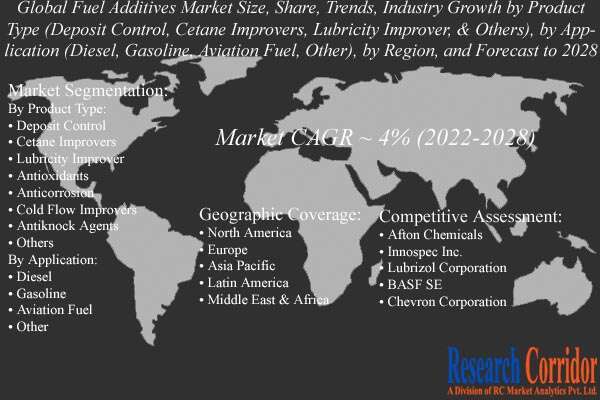
The global fuel additives market size is anticipated to register a significant CAGR of around 4% during the forecast period from 2022 to 2028. The growing demand for fuel additives in various applications such as aviation fuel, diesel, gasoline, and others is a major factor to drive the market growth. Furthermore, the growing sales in automotive and the increasing focus of automotive manufacturers to improve efficiency and enhance the performance of vehicles are further anticipated to fuel the market growth over the forecast period. Moreover, the increasing adoption of clean energy sources and the rising stringent government regulations regarding the environment are projected to propel market growth.
Market Drivers:
Stringent environmental regulations: Governments around the world are implementing strict regulations to reduce emissions from vehicles and industrial processes. Fuel additives play a crucial role in reducing harmful emissions, such as nitrogen oxides (NOx), particulate matter (PM), and greenhouse gases (GHGs). The need to comply with environmental regulations drives the demand for fuel additives.
Growing demand for clean and efficient fuels: With increasing concerns about air pollution and the need for sustainable energy sources, there is a growing demand for clean and efficient fuels. Fuel additives help improve the combustion efficiency of fuels, enhance fuel stability, prevent deposit formation, and reduce fuel consumption. The demand for fuel additives is driven by the desire to achieve cleaner and more efficient fuel utilization.
Increasing demand for biofuels: The demand for biofuels, such as ethanol and biodiesel, is growing due to their renewable and lower carbon footprint compared to fossil fuels. Fuel additives are used to enhance the performance and stability of biofuels, improve their compatibility with existing fuel infrastructure, and address potential issues such as water absorption and microbial growth. The expansion of the biofuels market drives the demand for fuel additives.
Need for fuel quality improvement: Fuel additives are used to improve the quality and performance of fuels. They can enhance fuel stability, prevent oxidation and degradation, improve lubricity, reduce corrosion, and inhibit the growth of microbial contaminants. The need to ensure fuel quality and protect engines and fuel systems drives the demand for fuel additives.
Increasing vehicle ownership and usage: The global growth in vehicle ownership, particularly in emerging economies, contributes to the demand for fuel additives. As more vehicles hit the roads, there is a greater need for efficient fuel consumption, reduced emissions, and improved engine performance. Fuel additives help address these requirements, making them essential for vehicle owners and fleet operators.
Technological advancements in fuel additive formulations: Ongoing advancements in fuel additive formulations have resulted in the development of more effective and tailored additives for specific fuel types and applications. Innovations such as multifunctional additives, nano-additives, and additive packages with customized formulations have expanded the application possibilities and effectiveness of fuel additives.
Growth in the industrial sector: Fuel additives are not only used in transportation fuels but also in industrial fuels, such as those used in power generation, manufacturing, and heating applications. The growth of the industrial sector, driven by industrialization, infrastructure development, and increasing energy demand, contributes to the demand for fuel additives.
Increasing focus on fuel efficiency and cost savings: Fuel additives can improve fuel efficiency by reducing fuel consumption, improving combustion, and minimizing engine deposits. With the rising fuel prices and the need to optimize operational costs, fuel efficiency has become a critical factor for businesses and consumers. The focus on fuel efficiency and cost savings drives the adoption of fuel additives.
Market Snapshot:
| Benchmark Year | 2022 | ||
| Market Size | lock | ||
| Market Growth (CAGR) | ~ 4% (2023-2030) | ||
| Largest Market Share | North America | ||
| Analysis Period | 2020-2030 | ||
| Market Players | Afton Chemicals, Innospec Inc., Lubrizol Corporation, BASF SE, and Chevron Corporation |
Market Insights:
The global fuel additives market is bifurcated into product type, application, and geography. On the basis of product type, the market is further segmented into deposit control, cetane improvers, lubricity improver, antioxidants, and others. The lubricity improver segment accounted to register the fastest growth rate in the market over the forecast period. The rising demand for ultra-low sulfur in various countries around the globe is a major factor to drive the segment growth. Furthermore, the stringent government regulations regarding fuel emissions in various economies are further anticipated to fuel the segment growth over the forecast period.
On the basis of application, the global fuel additives market is bifurcated into diesel, gasoline, aviation fuel, and others. The diesel segment is accounted to hold a significant market share in 2021 and is expected to grow at a fast growth rate over the forecast period. The growing consumption of diesel coupled with the heavy dosage of additives to improve efficiency and power is a major factor to drive the segment growth. Furthermore, the low emission of carbon dioxide as compared to others engines is further expected to fuel the segment growth over the forecast period.
To know more about the report, request sample papers
The fuel additives comprehensive study analyzes industry trends, market size, competitive analysis, and market forecast – 2022 to 2028. Research Corridor report provides detailed premium insight into the global market and reveals the potential revenue streams, commercial prospects, market drivers, challenges, opportunities, issues, and events affecting the industry. In addition, the report has a dedicated section covering market forecasts and analysis for leading geographies, profiles of major companies operating in the market, and expert opinions obtained from interviews with industry executives and experts from prominent companies.
The fuel additives market research report presents the analysis of each segment from 2019 to 2028 considering 2020 as the base year for the research. The compounded annual growth rate (CAGR) for each respective segment is calculated for the forecast period from 2021 to 2027.
Historical & Forecast Period
- 2019-20 – Historical Year
- 2021 – Base Year
- 2022-2028 – Forecast Period
Market Segmentation:
By Product Type:
- Deposit Control
- Cetane Improvers
- Lubricity Improver
- Antioxidants
- Anticorrosion
- Cold Flow Improvers
- Antiknock Agents
- Others
By Application:
- Diesel
- Gasoline
- Aviation Fuel
- Other
By Region:
- North America
- Europe
- Asia Pacific
- Latin America
- Middle East & Africa
Regional Analysis:
Geographically, North America dominated the global fuel additives market in 2021 and is expected to grow at the same trend over the forecast period. The high consumption of distillate fuel in various applications such as transportation, military, and power sectors is a major factor to drive the market growth in the region. Furthermore, the growing sales in automotive and the government regulations regarding emission control are further anticipated to fuel the market growth in North America. On the flip side, the Asia Pacific is expected to register the fastest growth rate in the market over the forecast period.
Competitive Assessment:
Some of the major market players operating in the global fuel additives market are Afton Chemicals, Innospec Inc., Lubrizol Corporation, BASF SE, and Chevron Corporation. Companies are exploring markets through expansion, new investment, the introduction of new services, and collaboration as their preferred strategies. Players are exploring new geography through expansion and acquisition to gain a competitive advantage through joint synergy.
Key Companies:
- Afton Chemicals
- Innospec Inc.
- Lubrizol Corporation
- BASF SE
- Chevron Corporation
- Evonik Industries AG
- LANXESS AG
- Dorf Ketal Chemicals
- Infineum International Limited
- Total SA
Key Questions Answered by Fuel Additives Market Report
- Global fuel additives market forecasts from 2022-2028
- Regional market forecasts from 2022-2028 covering Asia-Pacific, North America, Europe, Middle East & Africa, and Latin America
- Country-level forecasts from 2022-2028 covering 15 major countries from the regions as mentioned above
- Fuel additives submarket forecasts from 2022-2028 covering the market by product type, by application, and geography
- Various industry models such as SWOT analysis, Value Chain Analysis about the market
- Analysis of the key factors driving and restraining the growth of the global, regional, and country-level fuel additives markets from 2022-2028
- Competitive Landscape and market positioning of top 10 players operating in the market
1. Preface
1.1. Report Description
1.1.1. Purpose of the Report
1.1.2. Target Audience
1.1.3. USP and Key Offerings
1.2. Research Scope
1.3. Research Methodology
1.3.1. Phase I – Secondary Research
1.3.2. Phase II – Primary Research
1.3.3. Phase III – Expert Panel Review
1.4. Assumptions
2. Executive Summary
2.1. Global Fuel Additives Market Portraiture
2.2. Global Fuel Additives Market, by Product Type, 2021 (USD Mn)
2.3. Global Fuel Additives Market, by Application, 2021 (USD Mn)
2.4. Global Fuel Additives Market, by Geography, 2021 (USD Mn)
3. Global Fuel Additives Market Analysis
3.1. Fuel Additives Market Overview
3.2. Market Inclination Insights
3.3. Market Dynamics
3.3.1. Drivers
3.3.2. Challenges
3.3.3. Opportunities
3.4. Attractive Investment Proposition
3.5. Competitive Analysis
3.6. Porter’s Five Force Analysis
3.6.1. Bargaining Power of Suppliers
3.6.2. Bargaining Power of Buyers
3.6.3. Threat of New Entrants
3.6.4. Threat of Substitutes
3.6.5. Degree of Competition
3.7. COVID-19 Impact Analysis
4. Global Fuel Additives Market By Product Type, 2019 – 2028 (USD Mn)
4.1. Overview
4.2. Deposit Control
4.3. Cetane Improvers
4.4. Lubricity Improver
4.5. Antioxidants
4.6. Anticorrosion
4.7. Cold Flow Improvers
4.8. Antiknock Agents
4.9. Others
5. Global Fuel Additives Market By Application, 2019 – 2028 (USD Mn)
5.1. Overview
5.2. Diesel
5.3. Gasoline
5.4. Aviation Fuel
5.5. Other
6. North America Fuel Additives Market Analysis and Forecast, 2019 – 2028 (USD Mn)
6.1. Overview
6.2. North America Fuel Additives Market by Product Type, (2019-2028 USD Mn)
6.3. North America Fuel Additives Market by Application, (2019-2028 USD Mn)
6.4. North America Fuel Additives Market by Country, (2019-2028 USD Mn)
6.4.1. U.S.
6.4.1.1. U.S. Fuel Additives Market by Product Type, (2019-2028 USD Mn)
6.4.1.2. U.S. Fuel Additives Market by Application, (2019-2028 USD Mn)
6.4.2. Canada
6.4.2.1. Canada Fuel Additives Market by Product Type, (2019-2028 USD Mn)
6.4.2.2. Canada Fuel Additives Market by Application, (2019-2028 USD Mn)
7. Europe Fuel Additives Market Analysis and Forecast, 2019 – 2028 (USD Mn)
7.1. Overview
7.2. Europe Fuel Additives Market by Product Type, (2019-2028 USD Mn)
7.3. Europe Fuel Additives Market by Application, (2019-2028 USD Mn)
7.4. Europe Fuel Additives Market by Country, (2019-2028 USD Mn)
7.4.1. Germany
7.4.1.1. Germany Fuel Additives Market by Product Type, (2019-2028 USD Mn)
7.4.1.2. Germany Fuel Additives Market by Application, (2019-2028 USD Mn)
7.4.2. U.K.
7.4.2.1. U.K. Fuel Additives Market by Product Type, (2019-2028 USD Mn)
7.4.2.2. U.K. Fuel Additives Market by Application, (2019-2028 USD Mn)
7.4.3. France
7.4.3.1. France Fuel Additives Market by Product Type, (2019-2028 USD Mn)
7.4.3.2. France Fuel Additives Market by Application, (2019-2028 USD Mn)
7.4.4. Italy
7.4.4.1. Italy Fuel Additives Market by Product Type, (2019-2028 USD Mn)
7.4.4.2. Italy Fuel Additives Market by Application, (2019-2028 USD Mn)
7.4.5. Rest of Europe
7.4.5.1. Rest of Europe Fuel Additives Market by Product Type, (2019-2028 USD Mn)
7.4.5.2. Rest of Europe Fuel Additives Market by Application, (2019-2028 USD Mn)
8. Asia Pacific Fuel Additives Market Analysis and Forecast, 2019 – 2028 (USD Mn)
8.1. Overview
8.2. Asia Pacific Fuel Additives Market by Product Type, (2019-2028 USD Mn)
8.3. Asia Pacific Fuel Additives Market by Application, (2019-2028 USD Mn)
8.4. Asia Pacific Fuel Additives Market by Country, (2019-2028 USD Mn)
8.4.1. China
8.4.1.1. China Fuel Additives Market by Product Type, (2019-2028 USD Mn)
8.4.1.2. China Fuel Additives Market by Application, (2019-2028 USD Mn)
8.4.2. Japan
8.4.2.1. Japan Fuel Additives Market by Product Type, (2019-2028 USD Mn)
8.4.2.2. Japan Fuel Additives Market by Application, (2019-2028 USD Mn)
8.4.3. India
8.4.3.1. India Fuel Additives Market by Product Type, (2019-2028 USD Mn)
8.4.3.2. India Fuel Additives Market by Application, (2019-2028 USD Mn)
8.4.4. Rest of Asia Pacific
8.4.4.1. Rest of Asia Pacific Fuel Additives Market by Product Type, (2019-2028 USD Mn)
8.4.4.2. Rest of Asia Pacific Fuel Additives Market by Application, (2019-2028 USD Mn)
9. Latin America (LATAM) Fuel Additives Market Analysis and Forecast, 2019 – 2028 (USD Mn)
9.1. Overview
9.2. Latin America Fuel Additives Market by Product Type, (2019-2028 USD Mn)
9.3. Latin America Fuel Additives Market by Application, (2019-2028 USD Mn)
9.4. Latin America Fuel Additives Market by Country, (2019-2028 USD Mn)
9.4.1. Brazil
9.4.1.1. Brazil Fuel Additives Market by Product Type, (2019-2028 USD Mn)
9.4.1.2. Brazil Fuel Additives Market by Application, (2019-2028 USD Mn)
9.4.2. Mexico
9.4.2.1. Mexico Fuel Additives Market by Product Type, (2019-2028 USD Mn)
9.4.2.2. Mexico Fuel Additives Market by Application, (2019-2028 USD Mn)
9.4.3. Rest of Latin America
9.4.3.1. Rest of Latin America Fuel Additives Market by Product Type, (2019-2028 USD Mn)
9.4.3.2. Rest of Latin America Fuel Additives Market by Application, (2019-2028 USD Mn)
10. Middle East and Africa Fuel Additives Market Analysis and Forecast, 2019 – 2028 (USD Mn)
10.1. Overview
10.2. MEA Fuel Additives Market by Product Type, (2019-2028 USD Mn)
10.3. MEA Fuel Additives Market by Application, (2019-2028 USD Mn)
10.4. Middle East and Africa Fuel Additives Market, by Country, (2019-2028 USD Mn)
10.4.1. GCC
10.4.1.1. GCC Fuel Additives Market by Product Type, (2019-2028 USD Mn)
10.4.1.2. GCC Fuel Additives Market by Application, (2019-2028 USD Mn)
10.4.2. South Africa
10.4.2.1. South Africa Fuel Additives Market by Product Type, (2019-2028 USD Mn)
10.4.2.2. South Africa Fuel Additives Market by Application, (2019-2028 USD Mn)
10.4.3. Rest of MEA
10.4.3.1. Rest of MEA Fuel Additives Market by Product Type, (2019-2028 USD Mn)
10.4.3.2. Rest of MEA Fuel Additives Market by Application, (2019-2028 USD Mn)
11. Company Profiles
11.1. Afton Chemicals
11.1.1. Business Description
11.1.2. Financial Health and Budget Allocation
11.1.3. Product Positions/Portfolio
11.1.4. Recent Development
11.1.5. SWOT Analysis
11.2. Innospec Inc.
11.2.1. Business Description
11.2.2. Financial Health and Budget Allocation
11.2.3. Product Positions/Portfolio
11.2.4. Recent Development
11.2.5. SWOT Analysis
11.3. Lubrizol Corporation
11.3.1. Business Description
11.3.2. Financial Health and Budget Allocation
11.3.3. Product Positions/Portfolio
11.3.4. Recent Development
11.3.5. SWOT Analysis
11.4. BASF SE
11.4.1. Business Description
11.4.2. Financial Health and Budget Allocation
11.4.3. Product Positions/Portfolio
11.4.4. Recent Development
11.4.5. SWOT Analysis
11.5. Chevron Corporation
11.5.1. Business Description
11.5.2. Financial Health and Budget Allocation
11.5.3. Product Positions/Portfolio
11.5.4. Recent Development
11.5.5. SWOT Analysis
11.6. Evonik Industries AG
11.6.1. Business Description
11.6.2. Financial Health and Budget Allocation
11.6.3. Product Positions/Portfolio
11.6.4. Recent Development
11.6.5. SWOT Analysis
11.7. LANXESS AG
11.7.1. Business Description
11.7.2. Financial Health and Budget Allocation
11.7.3. Product Positions/Portfolio
11.7.4. Recent Development
11.7.5. SWOT Analysis
11.8. Dorf Ketal Chemicals
11.8.1. Business Description
11.8.2. Financial Health and Budget Allocation
11.8.3. Product Positions/Portfolio
11.8.4. Recent Development
11.8.5. SWOT Analysis
11.9. Infineum International Limited
11.9.1. Business Description
11.9.2. Financial Health and Budget Allocation
11.9.3. Product Positions/Portfolio
11.9.4. Recent Development
11.9.5. SWOT Analysis
11.10. Total SA
11.10.1. Business Description
11.10.2. Financial Health and Budget Allocation
11.10.3. Product Positions/Portfolio
11.10.4. Recent Development
11.10.5. SWOT Analysis
$ 5200/- Multi User License

We understand that every business has unique requirements. This report can be customized based on:
- Deep regional & country-level market intelligence
- Application-specific and end-use industry segmentation
- Competitive landscape & strategic benchmarking
- Go-to-market and expansion strategy insights
- Custom data cuts aligned to your business goals
- Structured Primary Research Framework
- On-Demand Industry Expert Interviews Available
- Dedicated Analyst Support
- Custom Data On Request
- Post-Purchase Strategy Consultation
- Complimentary 30-min Analyst Session
- 30% of Our Clients Are Returning Enterprise Buyers
Our Clients