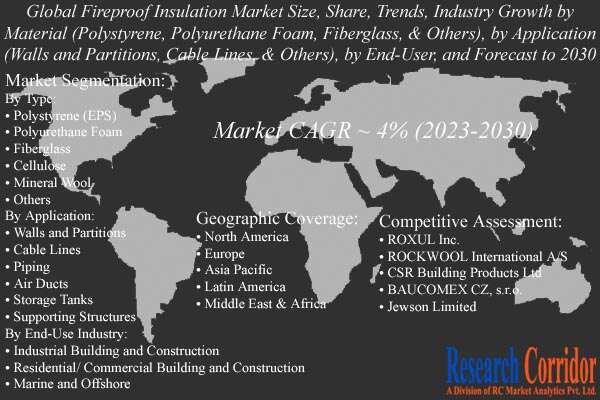
The global fireproof insulation market size is expected to grow at a CAGR of around 4% during the forecast period from 2023 to 2030. The significant growth in the construction industry coupled with the stringent regulation regarding safety for residential and commercial buildings is a prominent factor driving the industry growth. Furthermore, the significant growth in industrialization is further anticipated to boost the market growth over the forecast period. However, the lack of awareness regarding the benefits of fireproof insulation in several developing countries is expected to hinder the market growth.
Market Snapshot:
| Benchmark Year | 2022 | ||
| Market Size | $ xx.x Mn lock | ||
| Market Growth (CAGR) | ~ 4% (2023-2030) | ||
| Largest Market Share | Europe | ||
| Analysis Period | 2020-2030 | ||
| Market Players | ROXUL Inc., ROCKWOOL International A/S, CSR Building Products Ltd., BAUCOMEX CZ, s.r.o., and Jewson Limited |
Market Drivers:
Stringent Building Safety Regulations: Building safety regulations and codes require the implementation of fire-resistant materials and systems to enhance occupant safety and protect property from fire hazards. Fireproof insulation materials provide enhanced fire resistance and contribute to compliance with building safety regulations. The enforcement of stringent regulations has increased the demand for fireproof insulation in residential, commercial, and industrial construction.
Growing Focus on Fire Safety: The increasing awareness of fire safety and the need to mitigate fire risks have driven the demand for fireproof insulation. Fire accidents can cause significant property damage, economic losses, and loss of life. Fireproof insulation materials act as a barrier, limiting the spread of flames, smoke, and toxic gases during a fire. The growing focus on fire safety in buildings has spurred the adoption of fireproof insulation.
Rise in Construction Activities: The construction industry has witnessed significant growth worldwide, driven by urbanization, population growth, infrastructure development, and commercial construction projects. As construction activities increase, the need for fire-resistant materials, including fireproof insulation, has also risen. Fireproof insulation is used in various construction applications, such as walls, ceilings, floors, and HVAC systems, to provide passive fire protection.
Increased Adoption in Industrial and Manufacturing Facilities: Fireproof insulation finds extensive use in industrial and manufacturing facilities, where fire hazards are prevalent due to the presence of flammable materials, equipment, and processes. Fireproof insulation materials help in containing fire incidents, minimizing damage, and allowing safe evacuation. Industries such as oil and gas, petrochemicals, power generation, and chemical processing have high requirements for fire protection, driving the demand for fireproof insulation.
Energy Efficiency and Thermal Insulation: Fireproof insulation materials not only provide fire protection but also offer thermal insulation properties. These materials help in reducing heat transfer, preventing energy loss, and improving energy efficiency in buildings and industrial facilities. The focus on energy conservation and sustainable construction practices has led to the increased adoption of fireproof insulation with thermal insulation capabilities.
Advancements in Fireproof Insulation Technologies: Advances in fireproof insulation technologies have resulted in the development of more effective and efficient materials. Innovative fireproof insulation products offer improved fire resistance, durability, and ease of installation. Newer materials may also incorporate features such as moisture resistance, acoustic insulation, and resistance to mold and pests. These advancements have expanded the application possibilities and increased the demand for fireproof insulation.
Retrofitting and Renovation Projects: The retrofitting and renovation of existing buildings and structures present an opportunity for the adoption of fireproof insulation. Older buildings may lack adequate fire protection measures, and retrofitting with fireproof insulation can improve fire safety and compliance with modern building codes. Increasing renovation activities in commercial and residential sectors have contributed to the demand for fireproof insulation.
Insurance and Risk Mitigation: Insurance companies often incentivize or require the use of fire-resistant materials, including fireproof insulation, in buildings and structures. The installation of fireproof insulation can reduce fire-related risks and potential damages, leading to lower insurance premiums. The insurance industry’s influence in promoting fireproof insulation has played a role in driving its adoption in construction projects.
Fire Safety Awareness and Education: Increased awareness campaigns, educational programs, and fire safety initiatives have raised public awareness of the importance of fire protection in buildings. This increased awareness has created a demand for fireproof insulation as a key component of fire safety measures. Public knowledge and education regarding the benefits and requirements of fireproof insulation have contributed to market growth.
Market Insights:
By material, the polystyrene segment dominated the global fireproof insulation market in the benchmark year
The global fireproof insulation market is bifurcated into material, application, end-user, and geography. On the basis of material, the market is segmented into polystyrene (EPS), polyurethane foam, fiberglass, cellulose, and others. The polystyrene segment dominated the market in 2022 and is expected to hold the largest revenue share of around 1/3 market by the end of the analysis period. The low thermal conductivity of the material is a significant factor driving the segment growth. Furthermore, the properties associated with the material such as higher thermal and moisture resistance, superior compressive strength, and easy handling are further anticipated to increase the use of the material in fireproof insulation, which is fueling the segment growth.
By end-user, the industrial building and construction segment is accounted to hold the largest revenues share by 2030
On the basis of end-user, the market is segmented into industrial building and construction, residential/ commercial building and construction, and marine and offshore. The industrial building and construction segment is accounted to dominate the global fireproof insulation market in 2020 and expected to maintain its dominance over the forecast period. The increasing investment in industrial infrastructure around the world is one of the prominent factor driving the segment growth. Furthermore, the rising safety concern and the stringent government regulations regarding fire safety are further anticipated to propel the segment growth over the forecast period.
To know more about the research study, request sample papers
The fireproof insulation comprehensive study analyzes industry trends, market size, competitive analysis, and market forecast – 2023 to 2030. Research Corridor report provides detailed premium insight into the global market and reveals the potential revenue streams, commercial prospects, market drivers, challenges, opportunities, issues, and events affecting the industry. In addition, the report has a dedicated section covering market forecasts and analysis for leading geographies, profiles of major companies operating in the market and expert opinion obtained from interviews with industry executives and experts from prominent companies.
The fireproof insulation market research report presents the analysis of each segment from 2020 to 2030 considering 2022 as the base year for the research. The compounded annual growth rate (CAGR) for each respective segment is calculated for the forecast period from 2023 to 2030.
Historical & Forecast Period
- 2020-21 – Historical Year
- 2022 – Base Year
- 2023-2030 – Forecast Period
Market Segmentation:
By Type:
- Polystyrene (EPS)
- Polyurethane Foam
- Fiberglass
- Cellulose
- Mineral Wool
- Glass wool
- Rock wool
- Slag wool
By Application:
- Walls and Partitions
- Cable Lines
- Piping
- Air Ducts
- Storage Tanks
- Supporting Structures
By End-Use Industry:
- Industrial Building and Construction
- Residential/ Commercial Building and Construction
- Marine and Offshore
By Region:
- North America
- Europe
- Asia Pacific
- Latin America
- Middle East & Africa
Regional Analysis:
By region, Europe is accounted to hold the largest revenue share of over 1/3 market share by 2030
On the basis of region, Europe is accounted to dominate the global fireproof insulation market in 2022 and is expected to hold the largest revenue share of over 1/3 market share by the end of the analysis period. The growing construction activity in the region such as new construction, refurbishment, and redevelopment is a prominent factor driving the market growth in the region. Furthermore, the rising adoption of innovative products in the construction sector and the increasing inclination towards sustainable infrastructure based on stringent regulations are further anticipated to propel market growth in Europe. On the flip side, the Asia Pacific is estimated to grow at the fastest growth rate over the forecast period.
Geographically, the fireproof insulation market report comprises dedicated sections centering on the regional market revenue and trends. The fireproof insulation market has been segmented on the basis of geographic regions into North America, Europe, Asia Pacific, Latin America, and the Middle East & Africa. The fireproof insulation market has been extensively analyzed on the basis of various regional factors such as demographics, gross domestic product (GDP), inflation rate, acceptance, and others. Fireproof insulation market estimates have also been provided for the historical years 2020 & 2021 along with forecasts for the period from 2023 – 2030.
Competitive Assessment:
Some of the major market players operating in the global fireproof insulation market are ROXUL Inc., ROCKWOOL International A/S, CSR Building Products Ltd., BAUCOMEX CZ, s.r.o., and Jewson Limited. Companies are exploring markets through expansion, new investment, the introduction of new services, and collaboration as their preferred strategies. Players are exploring new geography through expansion and acquisition to gain a competitive advantage through joint synergy.
Key Companies:
- ROXUL Inc.
- ROCKWOOL International A/S
- CSR Building Products Ltd
- BAUCOMEX CZ, s.r.o.
- Jewson Limited
- BASF SE
- Combi Isolatie Tholen
- Refractory Specialties Incorporated
- airkrete
- Arango Insulation
Key Questions Answered by Fireproof Insulation Market Report
- Global fireproof insulation market forecasts from 2023-2030
- Regional market forecasts from 2023-2030 covering Asia-Pacific, North America, Europe, Middle East & Africa, and Latin America
- Country-level forecasts from 2023-2030 covering 15 major countries from the regions as mentioned above
- Fireproof insulation submarket forecasts from 2023-2030 covering the market by material, application, end-user, and geography
- Various industry models such as SWOT analysis, Value Chain Analysis about the market
- Analysis of the key factors driving and restraining the growth of the global, regional, and country-level fireproof insulation markets from 2023-2030
- Competitive Landscape and market positioning of the top 10 players operating in the market
1. Preface
1.1. Report Description
1.1.1. Purpose of the Report
1.1.2. Target Audience
1.1.3. USP and Key Offerings
1.2. Research Scope
1.3. Research Methodology
1.3.1. Phase I – Secondary Research
1.3.2. Phase II – Primary Research
1.3.3. Phase III – Expert Panel Review
1.4. Assumptions
2. Executive Summary
2.1. Global Fireproof Insulation Market Portraiture
2.2. Global Fireproof Insulation Market, by Material, 2022 (USD Mn)
2.3. Global Fireproof Insulation Market, by Application, 2022 (USD Mn)
2.4. Global Fireproof Insulation Market, by End-User, 2022 (USD Mn)
2.5. Global Fireproof Insulation Market, by Geography, 2022 (USD Mn)
3. Global Fireproof Insulation Market Analysis
3.1. Fireproof Insulation Market Overview
3.2. Market Inclination Insights
3.3. Market Dynamics
3.3.1. Drivers
3.3.2. Challenges
3.3.3. Opportunities
3.4. Attractive Investment Proposition
3.5. Competitive Analysis
3.6. Porter’s Five Force Analysis
3.6.1. Bargaining Power of Suppliers
3.6.2. Bargaining Power of Buyers
3.6.3. Threat of New Entrants
3.6.4. Threat of Substitutes
3.6.5. Degree of Competition
3.7. COVID-19 Impact Analysis
4. Global Fireproof Insulation Market By Material, 2020 – 2030 (USD Mn)
4.1. Overview
4.2. Polystyrene (EPS)
4.3. Polyurethane Foam
4.4. Fiberglass
4.5. Cellulose
4.6. Mineral Wool
4.7. Glass Wool
4.8. Rock Wool
4.9. Slag Wool
5. Global Fireproof Insulation Market By Application, 2020 – 2030 (USD Mn)
5.1. Overview
5.2. Walls and Partitions
5.3. Cable Lines
5.4. Piping
5.5. Air Ducts
5.6. Storage Tanks
5.7. Supporting Structures
6. Global Fireproof Insulation Market By End-User, 2020 – 2030 (USD Mn)
6.1. Overview
6.2. Industrial Building and Construction
6.3. Residential/ Commercial Building and Construction
6.4. Marine and Offshore
7. North America Fireproof Insulation Market Analysis and Forecast, 2020 – 2030 (USD Mn)
7.1. Overview
7.2. North America Fireproof Insulation Market by Material, (2020-2030 USD Mn)
7.3. North America Fireproof Insulation Market by Application, (2020-2030 USD Mn)
7.4. North America Fireproof Insulation Market by End-User, (2020-2030 USD Mn)
7.5. North America Fireproof Insulation Market by Country, (2020-2030 USD Mn)
7.5.1. U.S.
7.5.1.1. U.S. Fireproof Insulation Market by Material, (2020-2030 USD Mn)
7.5.1.2. U.S. Fireproof Insulation Market by Application, (2020-2030 USD Mn)
7.5.1.3. U.S. Fireproof Insulation Market by End-User, (2020-2030 USD Mn)
7.5.2. Canada
7.5.2.1. Canada Fireproof Insulation Market by Material, (2020-2030 USD Mn)
7.5.2.2. Canada Fireproof Insulation Market by Application, (2020-2030 USD Mn)
7.5.2.3. Canada Fireproof Insulation Market by End-User, (2020-2030 USD Mn)
8. Europe Fireproof Insulation Market Analysis and Forecast, 2020 - 2030 (USD Mn)
8.1. Overview
8.2. Europe Fireproof Insulation Market by Material, (2020-2030 USD Mn)
8.3. Europe Fireproof Insulation Market by Application, (2020-2030 USD Mn)
8.4. Europe Fireproof Insulation Market by End-User, (2020-2030 USD Mn)
8.5. Europe Fireproof Insulation Market by Country, (2020-2030 USD Mn)
8.5.1. Germany
8.5.1.1. Germany Fireproof Insulation Market by Material, (2020-2030 USD Mn)
8.5.1.2. Germany Fireproof Insulation Market by Application, (2020-2030 USD Mn)
8.5.1.3. Germany Fireproof Insulation Market by End-User, (2020-2030 USD Mn)
8.5.2. U.K.
8.5.2.1. U.K. Fireproof Insulation Market by Material, (2020-2030 USD Mn)
8.5.2.2. U.K. Fireproof Insulation Market by Application, (2020-2030 USD Mn)
8.5.2.3. U.K. Fireproof Insulation Market by End-User, (2020-2030 USD Mn)
8.5.3. France
8.5.3.1. France Fireproof Insulation Market by Material, (2020-2030 USD Mn)
8.5.3.2. France Fireproof Insulation Market by Application, (2020-2030 USD Mn)
8.5.3.3. France Fireproof Insulation Market by End-User, (2020-2030 USD Mn)
8.5.4. Spain
8.5.4.1. Spain Fireproof Insulation Market by Material, (2020-2030 USD Mn)
8.5.4.2. Spain Fireproof Insulation Market by Application, (2020-2030 USD Mn)
8.5.4.3. Spain Fireproof Insulation Market by End-User, (2020-2030 USD Mn)
8.5.5. Italy
8.5.5.1. Italy Fireproof Insulation Market by Material, (2020-2030 USD Mn)
8.5.5.2. Italy Fireproof Insulation Market by Application, (2020-2030 USD Mn)
8.5.5.3. Italy Fireproof Insulation Market by End-User, (2020-2030 USD Mn)
8.5.6. Rest of Europe
8.5.6.1. Rest of Europe Fireproof Insulation Market by Material, (2020-2030 USD Mn)
8.5.6.2. Rest of Europe Fireproof Insulation Market by Application, (2020-2030 USD Mn)
8.5.6.3. Rest of Europe Fireproof Insulation Market by End-User, (2020-2030 USD Mn)
9. Asia Pacific Fireproof Insulation Market Analysis and Forecast, 2020 - 2030 (USD Mn)
9.1. Overview
9.2. Asia Pacific Fireproof Insulation Market by Material, (2020-2030 USD Mn)
9.3. Asia Pacific Fireproof Insulation Market by Application, (2020-2030 USD Mn)
9.4. Asia Pacific Fireproof Insulation Market by End-User, (2020-2030 USD Mn)
9.5. Asia Pacific Fireproof Insulation Market by Country, (2020-2030 USD Mn)
9.5.1. China
9.5.1.1. China Fireproof Insulation Market by Material, (2020-2030 USD Mn)
9.5.1.2. China Fireproof Insulation Market by Application, (2020-2030 USD Mn)
9.5.1.3. China Fireproof Insulation Market by End-User, (2020-2030 USD Mn)
9.5.2. Japan
9.5.2.1. Japan Fireproof Insulation Market by Material, (2020-2030 USD Mn)
9.5.2.2. Japan Fireproof Insulation Market by Application, (2020-2030 USD Mn)
9.5.2.3. Japan Fireproof Insulation Market by End-User, (2020-2030 USD Mn)
9.5.3. India
9.5.3.1. India Fireproof Insulation Market by Material, (2020-2030 USD Mn)
9.5.3.2. India Fireproof Insulation Market by Application, (2020-2030 USD Mn)
9.5.3.3. India Fireproof Insulation Market by End-User, (2020-2030 USD Mn)
9.5.4. Rest of Asia Pacific
9.5.4.1. Rest of Asia Pacific Fireproof Insulation Market by Material, (2020-2030 USD Mn)
9.5.4.2. Rest of Asia Pacific Fireproof Insulation Market by Application, (2020-2030 USD Mn)
9.5.4.3. Rest of Asia Pacific Fireproof Insulation Market by End-User, (2020-2030 USD Mn)
10. Latin America (LATAM) Fireproof Insulation Market Analysis and Forecast, 2020 - 2030 (USD Mn)
10.1. Overview
10.2. Latin America Fireproof Insulation Market by Material, (2020-2030 USD Mn)
10.3. Latin America Fireproof Insulation Market by Application, (2020-2030 USD Mn)
10.4. Latin America Fireproof Insulation Market by End-User, (2020-2030 USD Mn)
10.5. Latin America Fireproof Insulation Market by Country, (2020-2030 USD Mn)
10.5.1. Brazil
10.5.1.1. Brazil Fireproof Insulation Market by Material, (2020-2030 USD Mn)
10.5.1.2. Brazil Fireproof Insulation Market by Application, (2020-2030 USD Mn)
10.5.1.3. Brazil Fireproof Insulation Market by End-User, (2020-2030 USD Mn)
10.5.2. Mexico
10.5.2.1. Mexico Fireproof Insulation Market by Material, (2020-2030 USD Mn)
10.5.2.2. Mexico Fireproof Insulation Market by Application, (2020-2030 USD Mn)
10.5.2.3. Mexico Fireproof Insulation Market by End-User, (2020-2030 USD Mn)
10.5.3. Rest of Latin America
10.5.3.1. Rest of Latin America Fireproof Insulation Market by Material, (2020-2030 USD Mn)
10.5.3.2. Rest of Latin America Fireproof Insulation Market by Application, (2020-2030 USD Mn)
10.5.3.3. Rest of Latin America Fireproof Insulation Market by End-User, (2020-2030 USD Mn)
11. Middle East and Africa Fireproof Insulation Market Analysis and Forecast, 2020 - 2030 (USD Mn)
11.1. Overview
11.2. MEA Fireproof Insulation Market by Material, (2020-2030 USD Mn)
11.3. MEA Fireproof Insulation Market by Application, (2020-2030 USD Mn)
11.4. MEA Fireproof Insulation Market by End-User, (2020-2030 USD Mn)
11.5. Middle East and Africa Fireproof Insulation Market, by Country, (2020-2030 USD Mn)
11.5.1. GCC
11.5.1.1. GCC Fireproof Insulation Market by Material, (2020-2030 USD Mn)
11.5.1.2. GCC Fireproof Insulation Market by Application, (2020-2030 USD Mn)
11.5.1.3. GCC Fireproof Insulation Market by End-User, (2020-2030 USD Mn)
11.5.2. South Africa
11.5.2.1. South Africa Fireproof Insulation Market by Material, (2020-2030 USD Mn)
11.5.2.2. South Africa Fireproof Insulation Market by Application, (2020-2030 USD Mn)
11.5.2.3. South Africa Fireproof Insulation Market by End-User, (2020-2030 USD Mn)
11.5.3. Rest of MEA
11.5.3.1. Rest of MEA Fireproof Insulation Market by Material, (2020-2030 USD Mn)
11.5.3.2. Rest of MEA Fireproof Insulation Market by Application, (2020-2030 USD Mn)
11.5.3.3. Rest of MEA Fireproof Insulation Market by End-User, (2020-2030 USD Mn)
12. Company Profiles
12.1. ROXUL Inc.
12.1.1. Business Description
12.1.2. Financial Health and Budget Allocation
12.1.3. Product Positions/Portfolio
12.1.4. Recent Development
12.1.5. SWOT Analysis
12.2. ROCKWOOL International A/S
12.2.1. Business Description
12.2.2. Financial Health and Budget Allocation
12.2.3. Product Positions/Portfolio
12.2.4. Recent Development
12.2.5. SWOT Analysis
12.3. CSR Building Products Ltd.
12.3.1. Business Description
12.3.2. Financial Health and Budget Allocation
12.3.3. Product Positions/Portfolio
12.3.4. Recent Development
12.3.5. SWOT Analysis
12.4. BAUCOMEX CZ, s.r.o.
12.4.1. Business Description
12.4.2. Financial Health and Budget Allocation
12.4.3. Product Positions/Portfolio
12.4.4. Recent Development
12.4.5. SWOT Analysis
12.5. Jewson Limited
12.5.1. Business Description
12.5.2. Financial Health and Budget Allocation
12.5.3. Product Positions/Portfolio
12.5.4. Recent Development
12.5.5. SWOT Analysis
12.6. BASF SE
12.6.1. Business Description
12.6.2. Financial Health and Budget Allocation
12.6.3. Product Positions/Portfolio
12.6.4. Recent Development
12.6.5. SWOT Analysis
12.7. Combi Isolatie Tholen
12.7.1. Business Description
12.7.2. Financial Health and Budget Allocation
12.7.3. Product Positions/Portfolio
12.7.4. Recent Development
12.7.5. SWOT Analysis
12.8. Refractory Specialties Incorporated
12.8.1. Business Description
12.8.2. Financial Health and Budget Allocation
12.8.3. Product Positions/Portfolio
12.8.4. Recent Development
12.8.5. SWOT Analysis
12.9. Airkrete
12.9.1. Business Description
12.9.2. Financial Health and Budget Allocation
12.9.3. Product Positions/Portfolio
12.9.4. Recent Development
12.9.5. SWOT Analysis
12.10. Arango Insulation
12.10.1. Business Description
12.10.2. Financial Health and Budget Allocation
12.10.3. Product Positions/Portfolio
12.10.4. Recent Development
12.10.5. SWOT Analysis
$ 5200/- Multi User License

We understand that every business has unique requirements. This report can be customized based on:
- Deep regional & country-level market intelligence
- Application-specific and end-use industry segmentation
- Competitive landscape & strategic benchmarking
- Go-to-market and expansion strategy insights
- Custom data cuts aligned to your business goals
- Structured Primary Research Framework
- On-Demand Industry Expert Interviews Available
- Dedicated Analyst Support
- Custom Data On Request
- Post-Purchase Strategy Consultation
- Complimentary 30-min Analyst Session
- 30% of Our Clients Are Returning Enterprise Buyers
Our Clients