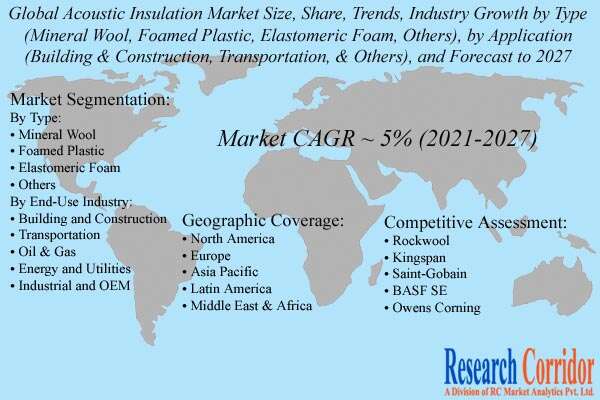
The global acoustic insulation market size is anticipated to witness a significant CAGR of around 5% during the forecast period 2021 to 2027. The significant demand for the product in various end-use industries such as oil & gas, building & construction, and transportation is a major factor to drive the market growth. Furthermore, the stringent regulations and the growing environmental concern are further anticipated to fuel the market growth over the forecast period. Moreover, the increasing demand for acoustic insulation among consumers for commercial and residential purposes is expected to propel market growth. However, the slowdown of construction activity in Europe and the required proper recycling techniques are some factor to restrain the market growth.
Market Drivers:
Growing Construction and Infrastructure Development: The construction industry plays a significant role in driving the demand for acoustic insulation. As urbanization and infrastructure development continue to expand globally, there is a greater need to control noise pollution and provide acoustic comfort in buildings, including residential, commercial, and industrial structures. Acoustic insulation materials are essential in reducing sound transmission and improving the acoustic performance of these buildings.
Increasing Awareness and Regulations for Noise Control: There is a growing awareness of the detrimental effects of noise pollution on human health and well-being. Regulatory bodies and governments have imposed stricter noise control regulations and standards, especially in densely populated areas and industrial zones. Compliance with these regulations necessitates the use of effective acoustic insulation materials and solutions, thereby driving market demand.
Technological Advancements in Acoustic Insulation: Ongoing research and development efforts have led to advancements in acoustic insulation technologies, resulting in the availability of more effective and innovative products. These advancements include the development of lightweight and high-performance materials with improved sound absorption and transmission loss capabilities. Technological innovations in acoustic insulation are driving market growth by offering better solutions to meet diverse application requirements.
Increasing Demand for Energy Efficiency: Acoustic insulation not only provides sound control but also contributes to energy efficiency in buildings. Insulation materials that possess both thermal and acoustic insulation properties help reduce energy consumption for heating, cooling, and air conditioning. The rising demand for energy-efficient buildings and sustainable construction practices drives the adoption of acoustic insulation materials that contribute to overall energy savings.
Growth in Automotive Industry: The automotive industry is a significant driver of the acoustic insulation market. As consumers increasingly demand quieter and more comfortable vehicles, automakers are incorporating acoustic insulation materials in vehicles to reduce noise levels inside the cabin. Acoustic insulation helps mitigate road noise, engine noise, and external sound transmission, enhancing the overall driving experience. The growth of the automotive industry, including electric vehicles, contributes to the demand for acoustic insulation materials.
Industrial Applications and Occupational Safety: Industrial facilities, such as manufacturing plants, power generation plants, and production facilities, often generate high levels of noise. Acoustic insulation materials are used to control and reduce noise levels in these environments, ensuring compliance with occupational safety standards and protecting workers’ hearing health. Industrial regulations and a focus on workplace safety drive the demand for acoustic insulation in industrial applications.
Increase in Retrofitting Activities: Retrofitting existing buildings with acoustic insulation materials is gaining popularity as a cost-effective solution to improve sound insulation. Many older buildings were not designed with adequate soundproofing measures, leading to noise issues. Retrofitting projects, driven by the need to enhance acoustic performance and occupant comfort, contribute to the demand for acoustic insulation materials.
Noise Control in Public Spaces: Public spaces, such as airports, railway stations, schools, hospitals, and entertainment venues, require effective noise control measures to ensure a comfortable environment for users. Acoustic insulation materials are employed in the construction and retrofitting of these spaces to reduce noise transmission and improve the overall acoustic experience, driving market demand.
Market Snapshot:
| Benchmark Year | 2022 | ||
| Market Size | lock | ||
| Market Growth (CAGR) | ~ 5% (2023-2030) | ||
| Largest Market Share | lock | ||
| Analysis Period | 2020-2030 | ||
| Market Players | Rockwool, Kingspan, Saint-Gobain, BASF SE, and Owens Corning |
Market Insights:
The global acoustic insulation market is bifurcated into type, end-use industry, and geography. On the basis of type, the market is further segmented into mineral wool, foamed plastic, elastomeric foam, and others. The elastomeric foam segment is accounted to register the highest growth rate over the forecast period. Due to its flexible nature, it is less vulnerable to crack, damage and material loss compare to others which is expected to fuel the segment growth.
On the basis of application, the market is segmented into building and construction, transportation, oil & gas and petrochemical, energy and utilities, and industrial and OEM. The building & construction segment dominated the global acoustic insulation market in 2020 and accounted to hold the largest revenue share of around half of the market by the end of the analysis period. The increasing construction activities around the globe are a primary factor to drive the segment growth. furthermore, the stringent regulation and the growing concern regarding the environment are further anticipated to propel the segment growth.
To know more about the study, request sample papers
The acoustic insulation comprehensive study analyzes industry trends, market size, competitive analysis, and market forecast – 2021 to 2027. Research Corridor report provides detailed premium insight into the global market and reveals the potential revenue streams, commercial prospects, market drivers, challenges, opportunities, issues, and events affecting the industry. In addition, the report has a dedicated section covering market forecasts and analysis for leading geographies, profiles of major companies operating in the market and expert opinion obtained from interviews with industry executives and experts from prominent companies.
The acoustic insulation market research report presents the analysis of each segment from 2018 to 2027 considering 2020 as the base year for the research. The compounded annual growth rate (CAGR) for each respective segment is calculated for the forecast period from 2021 to 2027.
Historical & Forecast Period
- 2018-19 – Historical Year
- 2020 – Base Year
- 2021-2027 – Forecast Period
Market Segmentation:
By Type:
- Mineral Wool
- Foamed Plastic
- Elastomeric Foam
- Others
By End-Use Industry:
- Building and Construction
- Transportation
- Oil & Gas
- Energy and Utilities
- Industrial and OEM
By Region:
- North America
- Europe
- Asia Pacific
- Latin America
- Middle East & Africa
Geographic Coverage
Geographically, the acoustic insulation market report comprises dedicated sections centering on the regional market revenue and trends. The acoustic insulation market has been segmented on the basis of geographic regions into North America, Europe, Asia Pacific, and Rest of the World (RoW). The RoW segment consists of Latin America and the Middle East & Africa. The acoustic insulation market has been extensively analyzed on the basis of various regional factors such as demographics, gross domestic product (GDP), inflation rate, acceptance, and others. Acoustic insulation market estimates have also been provided for the historical years 2018 & 2019 along with forecasts for the period from 2021 – 2027.
Competitive Assessment
Some of the major market players operating in the global acoustic insulation market are Rockwool, Kingspan, Saint-Gobain, BASF SE, and Owens Corning. Companies are exploring markets by expansion, new investment, the introduction of new services, and collaboration as their preferred strategies. Players are exploring new geography through expansion and acquisition to gain a competitive advantage through joint synergy.
Key Companies:
- Rockwool
- Kingspan
- Saint-Gobain
- BASF SE
- Owens Corning
- Lanxess
- Knauf Insulation
- Johns Manville
- Armacell
- Cellecta
Key Questions Answered by Acoustic Insulation Market Report
- Global acoustic insulation market forecasts from 2021-2027
- Regional acoustic insulation market forecasts from 2021-2027 covering Asia-Pacific, North America, Europe, Middle East & Africa, and Latin America
- Country-level forecasts from 2021-2027 covering 15 major countries from the regions as mentioned above
- Acoustic insulation submarket forecasts from 2021-2027 covering the market by type, by end-use industry, and geography
- Various industry models such as SWOT analysis, Value Chain Analysis about acoustic insulation market
- Analysis of the key factors driving and restraining the growth of the global, regional, and country-level acoustic insulation markets from 2021-2027
- Competitive Landscape and market positioning of top 10 players operating in the acoustic insulation market
1. Preface
1.1. Report Description
1.1.1. Purpose of the Report
1.1.2. Target Audience
1.1.3. USP and Key Offerings
1.2. Research Scope
1.3. Research Methodology
1.3.1. Phase I – Secondary Research
1.3.2. Phase II – Primary Research
1.3.3. Phase III – Expert Panel Review
1.4. Assumptions
2. Executive Summary
2.1. Global Acoustic Insulation Market Portraiture
2.2. Global Acoustic Insulation Market, by Type, 2020 (USD Mn)
2.3. Global Acoustic Insulation Market, by End-Use Industry, 2020 (USD Mn)
2.4. Global Acoustic Insulation Market, by Geography, 2020 (USD Mn)
3. Global Acoustic Insulation Market Analysis
3.1. Acoustic Insulation Market Overview
3.2. Market Inclination Insights
3.3. Market Dynamics
3.3.1. Drivers
3.3.2. Challenges
3.3.3. Opportunities
3.4. Attractive Investment Proposition
3.5. Competitive Analysis
3.6. Porter’s Five Force Analysis
3.6.1. Bargaining Power of Suppliers
3.6.2. Bargaining Power of Buyers
3.6.3. Threat of New Entrants
3.6.4. Threat of Substitutes
3.6.5. Degree of Competition
3.7. COVID-19 Impact Analysis
4. Global Acoustic Insulation Market By Type, 2018 – 2027 (USD Mn)
4.1. Overview
4.2. Mineral Wool
4.3. Foamed Plastic
4.4. Elastomeric Foam
4.5. Others
5. Global Acoustic Insulation Market By End-Use Industry, 2018 – 2027 (USD Mn)
5.1. Overview
5.2. Building and Construction
5.3. Transportation
5.4. Oil & Gas
5.5. Energy and Utilities
5.6. Industrial and OEM
6. North America Acoustic Insulation Market Analysis and Forecast, 2018 – 2027 (USD Mn)
6.1.1. Overview
6.1.2. North America Acoustic Insulation Market by Type (2018-2027 USD Mn)
6.1.3. North America Acoustic Insulation Market by End-Use Industry (2018-2027 USD Mn)
6.1.4. North America Acoustic Insulation Market by Country (2018-2027 USD Mn)
6.1.4.1. U.S.
6.1.4.1.1. U.S. Acoustic Insulation Market by Type (2018-2027 USD Mn)
6.1.4.1.2. U.S. Acoustic Insulation Market by End-Use Industry (2018-2027 USD Mn)
6.1.4.2. Canada
6.1.4.2.1. Canada Acoustic Insulation Market by Type (2018-2027 USD Mn)
6.1.4.2.2. Canada Acoustic Insulation Market by End-Use Industry (2018-2027 USD Mn)
7. Europe Acoustic Insulation Market Analysis and Forecast, 2018 – 2027 (USD Mn)
7.1.1. Overview
7.1.2. Europe Acoustic Insulation Market by Type (2018-2027 USD Mn)
7.1.3. Europe Acoustic Insulation Market by End-Use Industry (2018-2027 USD Mn)
7.1.4. Europe Acoustic Insulation Market by Country (2018-2027 USD Mn)
7.1.4.1. Germany
7.1.4.1.1. Germany Acoustic Insulation Market by Type (2018-2027 USD Mn)
7.1.4.1.2. Germany Acoustic Insulation Market by End-Use Industry (2018-2027 USD Mn)
7.1.4.2. U.K.
7.1.4.2.1. U.K. Acoustic Insulation Market by Type (2018-2027 USD Mn)
7.1.4.2.2. U.K. Acoustic Insulation Market by End-Use Industry (2018-2027 USD Mn)
7.1.4.3. France
7.1.4.3.1. France Acoustic Insulation Market by Type (2018-2027 USD Mn)
7.1.4.3.2. France Acoustic Insulation Market by End-Use Industry (2018-2027 USD Mn)
7.1.4.4. Italy
7.1.4.4.1. Italy Acoustic Insulation Market by Type (2018-2027 USD Mn)
7.1.4.4.2. Italy Acoustic Insulation Market by End-Use Industry (2018-2027 USD Mn)
7.1.4.5. Rest of Europe
7.1.4.5.1. Rest of Europe Acoustic Insulation Market by Type (2018-2027 USD Mn)
7.1.4.5.2. Rest of Europe Acoustic Insulation Market by End-Use Industry (2018-2027 USD Mn)
8. Asia Pacific Acoustic Insulation Market Analysis and Forecast, 2018 – 2027 (USD Mn)
8.1.1. Overview
8.1.2. Asia Pacific Acoustic Insulation Market by Type (2018-2027 USD Mn)
8.1.3. Asia Pacific Acoustic Insulation Market by End-Use Industry (2018-2027 USD Mn)
8.1.4. Asia Pacific Acoustic Insulation Market by Country (2018-2027 USD Mn)
8.1.4.1. China
8.1.4.1.1. China Acoustic Insulation Market by Type (2018-2027 USD Mn)
8.1.4.1.2. China Acoustic Insulation Market by End-Use Industry (2018-2027 USD Mn)
8.1.4.2. Japan
8.1.4.2.1. Japan Acoustic Insulation Market by Type (2018-2027 USD Mn)
8.1.4.2.2. Japan Acoustic Insulation Market by End-Use Industry (2018-2027 USD Mn)
8.1.4.3. Rest of Asia Pacific
8.1.4.3.1. Rest of Asia Pacific Acoustic Insulation Market by Type (2018-2027 USD Mn)
8.1.4.3.2. Rest of Asia Pacific Acoustic Insulation Market by End-Use Industry (2018-2027 USD Mn)
9. Latin America (LATAM) Acoustic Insulation Market Analysis and Forecast, 2018 – 2027 (USD Mn)
9.1.1. Overview
9.1.2. Latin America Acoustic Insulation Market by Type (2018-2027 USD Mn)
9.1.3. Latin America Acoustic Insulation Market by End-Use Industry (2018-2027 USD Mn)
9.1.4. Latin America Acoustic Insulation Market by Country (2018-2027 USD Mn)
9.1.4.1. Brazil
9.1.4.1.1. Brazil Acoustic Insulation Market by Type (2018-2027 USD Mn)
9.1.4.1.2. Brazil Acoustic Insulation Market by End-Use Industry (2018-2027 USD Mn)
9.1.4.2. Mexico
9.1.4.2.1. Mexico Acoustic Insulation Market by Type (2018-2027 USD Mn)
9.1.4.2.2. Mexico Acoustic Insulation Market by End-Use Industry (2018-2027 USD Mn)
9.1.4.3. Rest of Latin America
9.1.4.3.1. Rest of Latin America Acoustic Insulation Market by Type (2018-2027 USD Mn)
9.1.4.3.2. Rest of Latin America Acoustic Insulation Market by End-Use Industry (2018-2027 USD Mn)
10. Middle East and Africa Acoustic Insulation Market Analysis and Forecast, 2018 – 2027 (USD Mn)
10.1.1. Overview
10.1.2. MEA Acoustic Insulation Market by Type (2018-2027 USD Mn)
10.1.3. MEA Acoustic Insulation Market by End-Use Industry (2018-2027 USD Mn)
10.1.4. Middle East and Africa Acoustic Insulation Market, by Country (2018-2027 USD Mn)
10.1.4.1. GCC
10.1.4.1.1. GCC Acoustic Insulation Market by Type (2018-2027 USD Mn)
10.1.4.1.2. GCC Acoustic Insulation Market by End-Use Industry (2018-2027 USD Mn)
10.1.4.2. South Africa
10.1.4.2.1. South Africa Acoustic Insulation Market by Type (2018-2027 USD Mn)
10.1.4.2.2. South Africa Acoustic Insulation Market by End-Use Industry (2018-2027 USD Mn)
10.1.4.3. Rest of MEA
10.1.4.3.1. Rest of MEA Acoustic Insulation Market by Type (2018-2027 USD Mn)
10.1.4.3.2. Rest of MEA Acoustic Insulation Market by End-Use Industry (2018-2027 USD Mn)
11. Company Profiles
11.1. Rockwool
11.1.1. Business Description
11.1.2. Financial Health and Budget Allocation
11.1.3. Product Positions/Portfolio
11.1.4. Recent Development
11.1.5. SWOT Analysis
11.2. Kingspan
11.2.1. Business Description
11.2.2. Financial Health and Budget Allocation
11.2.3. Product Positions/Portfolio
11.2.4. Recent Development
11.2.5. SWOT Analysis
11.3. Saint-Gobain
11.3.1. Business Description
11.3.2. Financial Health and Budget Allocation
11.3.3. Product Positions/Portfolio
11.3.4. Recent Development
11.3.5. SWOT Analysis
11.4. BASF SE
11.4.1. Business Description
11.4.2. Financial Health and Budget Allocation
11.4.3. Product Positions/Portfolio
11.4.4. Recent Development
11.4.5. SWOT Analysis
11.5. Owens Corning
11.5.1. Business Description
11.5.2. Financial Health and Budget Allocation
11.5.3. Product Positions/Portfolio
11.5.4. Recent Development
11.5.5. SWOT Analysis
11.6. Lanxess
11.6.1. Business Description
11.6.2. Financial Health and Budget Allocation
11.6.3. Product Positions/Portfolio
11.6.4. Recent Development
11.6.5. SWOT Analysis
11.7. Knauf Insulation
11.7.1. Business Description
11.7.2. Financial Health and Budget Allocation
11.7.3. Product Positions/Portfolio
11.7.4. Recent Development
11.7.5. SWOT Analysis
11.8. Johns Manville
11.8.1. Business Description
11.8.2. Financial Health and Budget Allocation
11.8.3. Product Positions/Portfolio
11.8.4. Recent Development
11.8.5. SWOT Analysis
11.9. Armacell
11.9.1. Business Description
11.9.2. Financial Health and Budget Allocation
11.9.3. Product Positions/Portfolio
11.9.4. Recent Development
11.9.5. SWOT Analysis
11.10. Cellecta
11.10.1. Business Description
11.10.2. Financial Health and Budget Allocation
11.10.3. Product Positions/Portfolio
11.10.4. Recent Development
11.10.5. SWOT Analysis
$ 5200/- Multi User License

We understand that every business has unique requirements. This report can be customized based on:
- Deep regional & country-level market intelligence
- Application-specific and end-use industry segmentation
- Competitive landscape & strategic benchmarking
- Go-to-market and expansion strategy insights
- Custom data cuts aligned to your business goals
- Structured Primary Research Framework
- On-Demand Industry Expert Interviews Available
- Dedicated Analyst Support
- Custom Data On Request
- Post-Purchase Strategy Consultation
- Complimentary 30-min Analyst Session
- 30% of Our Clients Are Returning Enterprise Buyers
Our Clients