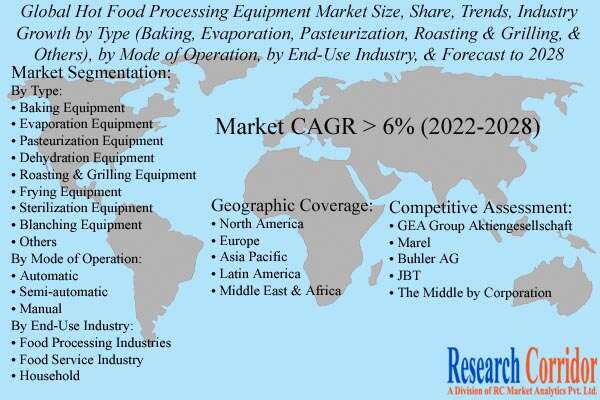
The global hot food processing equipment market size is projected to grow at a significant CAGR of over 6% during the forecast period 2022 to 2028. The growing consumption of fast food and the increasing demand for packaged food around the world is a major factor driving the market growth. Furthermore, the growing urbanization, changing lifestyles, and changing consumer food habits are expected to increase the demand for processed food which is further anticipated to fuel the market growth. Moreover, the innovation in food processing techniques, increasing preference for healthy and functional food, and increasing disposable income in developing economies are projected to propel market growth over the forecast period.
Market Drivers:
Increasing Demand for Processed and Ready-to-Eat Foods: The growing demand for convenience foods and ready-to-eat meals is driving the need for hot food processing equipment. These equipment enable efficient and large-scale processing of various food products, including cooked meats, baked goods, soups, sauces, and prepared meals, to meet the demand for convenient and quick food options.
Changing Consumer Lifestyles and Food Preferences: Shifts in consumer lifestyles, such as busy schedules and a desire for quick meals, drive the demand for hot food processing equipment. Consumers are increasingly looking for time-saving solutions and are willing to purchase processed foods that require minimal cooking or preparation. Hot food processing equipment enables manufacturers to produce a wide range of processed food products to cater to these changing consumer preferences.
Technological Advancements and Automation: Technological advancements in hot food processing equipment have led to improved efficiency, productivity, and food safety. Automation and advanced control systems help streamline the food processing operations, reduce labor requirements, enhance product consistency, and ensure compliance with food safety regulations. These advancements drive the adoption of hot food processing equipment by manufacturers.
Food Safety and Quality Standards: The stringent food safety and quality standards imposed by regulatory bodies and consumer expectations drive the need for reliable and hygienic hot food processing equipment. Manufacturers are required to meet these standards to ensure the safety and quality of their processed food products. Hot food processing equipment with features such as temperature control, sanitary design, and ease of cleaning help meet these requirements.
Demand for Extended Shelf Life and Preservation: Hot food processing equipment plays a crucial role in preserving and extending the shelf life of food products. Techniques such as canning, retorting, pasteurization, and thermal processing are employed to eliminate or inhibit microbial growth, extend product shelf life, and maintain food quality. The demand for longer shelf life and preserved foods drives the adoption of hot food processing equipment.
Cost and Operational Efficiency: Hot food processing equipment enables manufacturers to achieve cost and operational efficiency by reducing manual labor, optimizing production processes, and minimizing waste. These equipment facilitate large-scale production, ensuring consistent quality and reducing production costs per unit. Manufacturers strive to improve operational efficiency to remain competitive, driving the demand for hot food processing equipment.
Globalization of Food Trade: The globalization of the food industry has led to an increase in international food trade and the need for standardized food processing practices. Hot food processing equipment helps meet the regulatory and quality requirements for exporting processed food products across different countries and regions. The expansion of food trade drives the demand for hot food processing equipment.
Emerging Food Technologies and Product Innovation: The introduction of new food processing technologies and product innovation drives the demand for hot food processing equipment. Manufacturers are constantly exploring new techniques and processes to develop innovative food products with improved taste, texture, nutritional value, and convenience. Hot food processing equipment enables the implementation of these technologies and supports product innovation.
Expansion of Foodservice and Hospitality Industry: The growth of the food service and hospitality industry, including restaurants, hotels, catering services, and quick-service establishments, contributes to the demand for hot food processing equipment. These establishments require efficient and reliable equipment to prepare and serve hot food items on a large scale, meeting the demands of their customers.
Market Snapshot:
| Benchmark Year | 2022 | ||
| Market Size | lock | ||
| Market Growth (CAGR) | > 6% (2023-2030) | ||
| Largest Market Share | Asia Pacific | ||
| Analysis Period | 2020-2030 | ||
| Market Players | GEA Group Aktiengesellschaft, Marel, Buhler AG, JBT, and The Middle by Corporation |
Market Insights:
The global hot food processing equipment market is bifurcated into type, mode of operation, end-use industry, and geography. On the basis of type, the market is further segmented into baking equipment, dehydration equipment, roasting & grilling equipment, frying equipment, and others. The baking equipment segment dominated the global market in 2021 and expected to maintain its dominance over the forecast period. The increasing demand for ready-to-eat food across the globe is a major factor to drive the segment growth. Furthermore, the changing lifestyle and the growing consumption of healthy snacks are further expected to fuel the segment growth over the forecast period. On the other hand, the food dehydrator equipment segment is estimated to register a fast growth rate over the forecast period.
On the basis of mode of operation, the market is segmented into automatic, semi-automatic, and manual. The automatic segment dominated the global hot food processing equipment market in 2021 and expected to hold the largest revenue share of over half of the market by the end of the analysis period. The benefits associated with the equipment such as consistent quality, high food safety, hygiene, and greater compliance with the legal specifications are some major factors to drive the segment growth. Furthermore, the increasing adoption of this equipment by food processing manufacturers heat exchangers, ovens, pasteurizers, evaporators, and sterilizers are further expected to fuel the segment growth over the forecast period.
To know more about the study, request sample papers
The hot food processing equipment comprehensive study analyzes industry trends, market size, competitive analysis, and market forecast – 2022 to 2028. Research Corridor report provides detailed premium insight into the global market and reveals the potential revenue streams, commercial prospects, market drivers, challenges, opportunities, issues, and events affecting the industry. In addition, the report has a dedicated section covering market forecasts and analysis for leading geographies, profiles of major companies operating in the market and expert opinion obtained from interviews with industry executives and experts from prominent companies.
The hot food processing equipment market research report presents the analysis of each segment from 2019 to 2028 considering 2020 as the base year for the research. The compounded annual growth rate (CAGR) for each respective segment is calculated for the forecast period from 2021 to 2027.
Historical & Forecast Period
- 2019-20 – Historical Year
- 2021 – Base Year
- 2022-2028 – Forecast Period
Market Segmentation:
By Type:
- Baking Equipment
- Evaporation Equipment
- Pasteurization Equipment
- Dehydration Equipment
- Roasting & Grilling Equipment
- Frying Equipment
- Sterilization Equipment
- Blanching Equipment
- Others
By Mode of Operation:
- Automatic
- Semi-automatic
- Manual
By End-Use Industry:
- Food Processing Industries
- Food Service Industry
- Fast food solutions
- Restaurant
- Cafes & Bars
- Caterers
- Cloud kitchens
- Vending machine
- Others
- Household
By Region:
- North America
- Europe
- Asia Pacific
- Latin America
- Middle East & Africa
Regional Analysis:
Geographically, the Asia Pacific dominated the global hot food processing equipment market in 2021 and expected to hold the largest revenue share of over one-third market share by the end of the analysis period. The rising health awareness and the growing popularity of processed food among millennials are some major factor to drive the market growth in the region. Furthermore, the growing urbanization, changing lifestyle, and the increasing disposable income per capita are further expected to fuel the market in the Asia Pacific.
Competitive Assessment:
Some of the major market players operating in the global hot food processing equipment market are GEA Group Aktiengesellschaft, Marel, Buhler AG, JBT, and The Middle by Corporation. Companies are exploring markets by expansion, new investment, the introduction of new services, and collaboration as their preferred strategies. Players are exploring new geography through expansion and acquisition to gain a competitive advantage through joint synergy.
Key Companies:
- GEA Group Aktiengesellschaft
- Marel
- Buhler AG
- JBT
- The Middle by Corporation
- SPX Flow
- Heat & Control, Inc.
- Alfa Laval
- Tetra Laval International S.A
- TNA Australia Pty Limited
Key Questions Answered by Hot Food Processing Equipment Market Report
- Global hot food processing equipment market forecasts from 2022-2028
- Regional market forecasts from 2022-2028 covering Asia-Pacific, North America, Europe, Middle East & Africa, and Latin America
- Country-level forecasts from 2022-2028 covering 15 major countries from the regions as mentioned above
- Hot food processing equipment submarket forecasts from 2022-2028 covering the market by type, by mode of operation, by end-use industry, and geography
- Various industry models such as SWOT analysis, Value Chain Analysis about the market
- Analysis of the key factors driving and restraining the growth of the global, regional, and country-level hot food processing equipment markets from 2022-2028
- Competitive Landscape and market positioning of top 10 players operating in the market
1. Preface
1.1. Report Description
1.1.1. Purpose of the Report
1.1.2. Target Audience
1.1.3. USP and Key Offerings
1.2. Research Scope
1.3. Research Methodology
1.3.1. Phase I – Secondary Research
1.3.2. Phase II – Primary Research
1.3.3. Phase III – Expert Panel Review
1.4. Assumptions
2. Executive Summary
2.1. Global Hot Food Processing Equipment Market Portraiture
2.2. Global Hot Food Processing Equipment Market, by Type, 2021 (USD Mn)
2.3. Global Hot Food Processing Equipment Market, by Mode of Operation, 2021 (USD Mn)
2.4. Global Hot Food Processing Equipment Market, by End-Use Industry, 2021 (USD Mn)
2.5. Global Hot Food Processing Equipment Market, by Geography, 2021 (USD Mn)
3. Global Hot Food Processing Equipment Market Analysis
3.1. Hot Food Processing Equipment Market Overview
3.2. Market Inclination Insights
3.3. Market Dynamics
3.3.1. Drivers
3.3.2. Challenges
3.3.3. Opportunities
3.4. Attractive Investment Proposition
3.5. Competitive Analysis
3.6. Porter’s Five Force Analysis
3.6.1. Bargaining Power of Suppliers
3.6.2. Bargaining Power of Buyers
3.6.3. Threat of New Entrants
3.6.4. Threat of Substitutes
3.6.5. Degree of Competition
3.7. COVID-19 Impact Analysis
4. Global Hot Food Processing Equipment Market By Type, 2019 – 2028 (USD Mn)
4.1. Overview
4.2. Baking Equipment
4.3. Evaporation Equipment
4.4. Pasteurization Equipment
4.5. Dehydration Equipment
4.6. Roasting & Grilling Equipment
4.7. Frying Equipment
4.8. Sterilization Equipment
4.9. Blanching Equipment
4.10. Others
5. Global Hot Food Processing Equipment Market By Mode of Operation, 2019 – 2028 (USD Mn)
5.1. Overview
5.2. Automatic
5.3. Semi-automatic
5.4. Manual
6. Global Hot Food Processing Equipment Market By End-Use Industry, 2019 – 2028 (USD Mn)
6.1. Overview
6.2. Food Processing Industries
6.3. Food Service Industry
6.3.1. Fast food solutions
6.3.2. Restaurant
6.3.3. Cafes & Bars
6.3.4. Caterers
6.3.5. Cloud kitchens
6.3.6. Vending machine
6.3.7. Others
6.4. Household
7. North America Hot Food Processing Equipment Market Analysis and Forecast, 2019 – 2028 (USD Mn)
7.1. Overview
7.2. North America Hot Food Processing Equipment Market by Type (2019-2028 USD Mn)
7.3. North America Hot Food Processing Equipment Market by Mode of Operation (2019-2028 USD Mn)
7.4. North America Hot Food Processing Equipment Market by End-Use Industry (2019-2028 USD Mn)
7.5. North America Hot Food Processing Equipment Market by Country (2019-2028 USD Mn)
7.5.1. U.S.
7.5.1.1. U.S. Hot Food Processing Equipment Market by Type (2019-2028 USD Mn)
7.5.1.2. U.S. Hot Food Processing Equipment Market by Mode of Operation (2019-2028 USD Mn)
7.5.1.3. U.S. Hot Food Processing Equipment Market by End-Use Industry (2019-2028 USD Mn)
7.5.2. Canada
7.5.2.1. Canada Hot Food Processing Equipment Market by Type (2019-2028 USD Mn)
7.5.2.2. Canada Hot Food Processing Equipment Market by Mode of Operation (2019-2028 USD Mn)
7.5.2.3. Canada Hot Food Processing Equipment Market by End-Use Industry (2019-2028 USD Mn)
8. Europe Hot Food Processing Equipment Market Analysis and Forecast, 2019 – 2028 (USD Mn)
8.1. Overview
8.2. Europe Hot Food Processing Equipment Market by Type (2019-2028 USD Mn)
8.3. Europe Hot Food Processing Equipment Market by Mode of Operation (2019-2028 USD Mn)
8.4. Europe Hot Food Processing Equipment Market by End-Use Industry (2019-2028 USD Mn)
8.5. Europe Hot Food Processing Equipment Market by Country (2019-2028 USD Mn)
8.5.1. Germany
8.5.1.1. Germany Hot Food Processing Equipment Market by Type (2019-2028 USD Mn)
8.5.1.2. Germany Hot Food Processing Equipment Market by Mode of Operation (2019-2028 USD Mn)
8.5.1.3. Germany Hot Food Processing Equipment Market by End-Use Industry (2019-2028 USD Mn)
8.5.2. U.K.
8.5.2.1. U.K. Hot Food Processing Equipment Market by Type (2019-2028 USD Mn)
8.5.2.2. U.K. Hot Food Processing Equipment Market by Mode of Operation (2019-2028 USD Mn)
8.5.2.3. U.K. Hot Food Processing Equipment Market by End-Use Industry (2019-2028 USD Mn)
8.5.3. France
8.5.3.1. France Hot Food Processing Equipment Market by Type (2019-2028 USD Mn)
8.5.3.2. France Hot Food Processing Equipment Market by Mode of Operation (2019-2028 USD Mn)
8.5.3.3. France Hot Food Processing Equipment Market by End-Use Industry (2019-2028 USD Mn)
8.5.4. Italy
8.5.4.1. Italy Hot Food Processing Equipment Market by Type (2019-2028 USD Mn)
8.5.4.2. Italy Hot Food Processing Equipment Market by Mode of Operation (2019-2028 USD Mn)
8.5.4.3. Italy Hot Food Processing Equipment Market by End-Use Industry (2019-2028 USD Mn)
8.5.5. Rest of Europe
8.5.5.1. Rest of Europe Hot Food Processing Equipment Market by Type (2019-2028 USD Mn)
8.5.5.2. Rest of Europe Hot Food Processing Equipment Market by Mode of Operation (2019-2028 USD Mn)
8.5.5.3. Rest of Europe Hot Food Processing Equipment Market by End-Use Industry (2019-2028 USD Mn)
9. Asia Pacific Hot Food Processing Equipment Market Analysis and Forecast, 2019 – 2028 (USD Mn)
9.1. Overview
9.2. Asia Pacific Hot Food Processing Equipment Market by Type (2019-2028 USD Mn)
9.3. Asia Pacific Hot Food Processing Equipment Market by Mode of Operation (2019-2028 USD Mn)
9.4. Asia Pacific Hot Food Processing Equipment Market by End-Use Industry (2019-2028 USD Mn)
9.5. Asia Pacific Hot Food Processing Equipment Market by Country (2019-2028 USD Mn)
9.5.1. China
9.5.1.1. China Hot Food Processing Equipment Market by Type (2019-2028 USD Mn)
9.5.1.2. China Hot Food Processing Equipment Market by Mode of Operation (2019-2028 USD Mn)
9.5.1.3. China Hot Food Processing Equipment Market by End-Use Industry (2019-2028 USD Mn)
9.5.2. Japan
9.5.2.1. Japan Hot Food Processing Equipment Market by Type (2019-2028 USD Mn)
9.5.2.2. Japan Hot Food Processing Equipment Market by Mode of Operation (2019-2028 USD Mn)
9.5.2.3. Japan Hot Food Processing Equipment Market by End-Use Industry (2019-2028 USD Mn)
9.5.3. India
9.5.3.1. India Hot Food Processing Equipment Market by Type (2019-2028 USD Mn)
9.5.3.2. India Hot Food Processing Equipment Market by Mode of Operation (2019-2028 USD Mn)
9.5.3.3. India Hot Food Processing Equipment Market by End-Use Industry (2019-2028 USD Mn)
9.5.4. Rest of Asia Pacific
9.5.4.1. Rest of Asia Pacific Hot Food Processing Equipment Market by Type (2019-2028 USD Mn)
9.5.4.2. Rest of Asia Pacific Hot Food Processing Equipment Market by Mode of Operation (2019-2028 USD Mn)
9.5.4.3. Rest of Asia Pacific Hot Food Processing Equipment Market by End-Use Industry (2019-2028 USD Mn)
10. Latin America (LATAM) Hot Food Processing Equipment Market Analysis and Forecast, 2019 – 2028 (USD Mn)
10.1. Overview
10.2. Latin America Hot Food Processing Equipment Market by Type (2019-2028 USD Mn)
10.3. Latin America Hot Food Processing Equipment Market by Mode of Operation (2019-2028 USD Mn)
10.4. Latin America Hot Food Processing Equipment Market by End-Use Industry (2019-2028 USD Mn)
10.5. Latin America Hot Food Processing Equipment Market by Country (2019-2028 USD Mn)
10.5.1. Brazil
10.5.1.1. Brazil Hot Food Processing Equipment Market by Type (2019-2028 USD Mn)
10.5.1.2. Brazil Hot Food Processing Equipment Market by Mode of Operation (2019-2028 USD Mn)
10.5.1.3. Brazil Hot Food Processing Equipment Market by End-Use Industry (2019-2028 USD Mn)
10.5.2. Mexico
10.5.2.1. Mexico Hot Food Processing Equipment Market by Type (2019-2028 USD Mn)
10.5.2.2. Mexico Hot Food Processing Equipment Market by Mode of Operation (2019-2028 USD Mn)
10.5.2.3. Mexico Hot Food Processing Equipment Market by End-Use Industry (2019-2028 USD Mn)
10.5.3. Rest of Latin America
10.5.3.1. Rest of Latin America Hot Food Processing Equipment Market by Type (2019-2028 USD Mn)
10.5.3.2. Rest of Latin America Hot Food Processing Equipment Market by Mode of Operation (2019-2028 USD Mn)
10.5.3.3. Rest of Latin America Hot Food Processing Equipment Market by End-Use Industry (2019-2028 USD Mn)
11. Middle East and Africa Hot Food Processing Equipment Market Analysis and Forecast, 2019 – 2028 (USD Mn)
11.1. Overview
11.2. MEA Hot Food Processing Equipment Market by Type (2019-2028 USD Mn)
11.3. MEA Hot Food Processing Equipment Market by Mode of Operation (2019-2028 USD Mn)
11.4. MEA Hot Food Processing Equipment Market by End-Use Industry (2019-2028 USD Mn)
11.5. Middle East and Africa Hot Food Processing Equipment Market, by Country (2019-2028 USD Mn)
11.5.1. GCC
11.5.1.1. GCC Hot Food Processing Equipment Market by Type (2019-2028 USD Mn)
11.5.1.2. GCC Hot Food Processing Equipment Market by Mode of Operation (2019-2028 USD Mn)
11.5.1.3. GCC Hot Food Processing Equipment Market by End-Use Industry (2019-2028 USD Mn)
11.5.2. South Africa
11.5.2.1. South Africa Hot Food Processing Equipment Market by Type (2019-2028 USD Mn)
11.5.2.2. South Africa Hot Food Processing Equipment Market by Mode of Operation (2019-2028 USD Mn)
11.5.2.3. South Africa Hot Food Processing Equipment Market by End-Use Industry (2019-2028 USD Mn)
11.5.3. Rest of MEA
11.5.3.1. Rest of MEA Hot Food Processing Equipment Market by Type (2019-2028 USD Mn)
11.5.3.2. Rest of MEA Hot Food Processing Equipment Market by Mode of Operation (2019-2028 USD Mn)
11.5.3.3. Rest of MEA Hot Food Processing Equipment Market by End-Use Industry (2019-2028 USD Mn)
12. Company Profiles
12.1. GEA Group Aktiengesellschaft
12.1.1. Business Description
12.1.2. Financial Health and Budget Allocation
12.1.3. Product Positions/Portfolio
12.1.4. Recent Development
12.1.5. SWOT Analysis
12.2. Marel
12.2.1. Business Description
12.2.2. Financial Health and Budget Allocation
12.2.3. Product Positions/Portfolio
12.2.4. Recent Development
12.2.5. SWOT Analysis
12.3. Buhler AG
12.3.1. Business Description
12.3.2. Financial Health and Budget Allocation
12.3.3. Product Positions/Portfolio
12.3.4. Recent Development
12.3.5. SWOT Analysis
12.4. JBT
12.4.1. Business Description
12.4.2. Financial Health and Budget Allocation
12.4.3. Product Positions/Portfolio
12.4.4. Recent Development
12.4.5. SWOT Analysis
12.5. The Middle by Corporation
12.5.1. Business Description
12.5.2. Financial Health and Budget Allocation
12.5.3. Product Positions/Portfolio
12.5.4. Recent Development
12.5.5. SWOT Analysis
12.6. SPX Flow
12.6.1. Business Description
12.6.2. Financial Health and Budget Allocation
12.6.3. Product Positions/Portfolio
12.6.4. Recent Development
12.6.5. SWOT Analysis
12.7. Heat & Control, Inc.
12.7.1. Business Description
12.7.2. Financial Health and Budget Allocation
12.7.3. Product Positions/Portfolio
12.7.4. Recent Development
12.7.5. SWOT Analysis
12.8. Alfa Laval
12.8.1. Business Description
12.8.2. Financial Health and Budget Allocation
12.8.3. Product Positions/Portfolio
12.8.4. Recent Development
12.8.5. SWOT Analysis
12.9. Tetra Laval International S.A
12.9.1. Business Description
12.9.2. Financial Health and Budget Allocation
12.9.3. Product Positions/Portfolio
12.9.4. Recent Development
12.9.5. SWOT Analysis
12.10. TNA Australia Pty Limited
12.10.1. Business Description
12.10.2. Financial Health and Budget Allocation
12.10.3. Product Positions/Portfolio
12.10.4. Recent Development
12.10.5. SWOT Analysis
$ 5200/- Multi User License

We understand that every business has unique requirements. This report can be customized based on:
- Deep regional & country-level market intelligence
- Application-specific and end-use industry segmentation
- Competitive landscape & strategic benchmarking
- Go-to-market and expansion strategy insights
- Custom data cuts aligned to your business goals
- Structured Primary Research Framework
- On-Demand Industry Expert Interviews Available
- Dedicated Analyst Support
- Custom Data On Request
- Post-Purchase Strategy Consultation
- Complimentary 30-min Analyst Session
- 30% of Our Clients Are Returning Enterprise Buyers
Our Clients