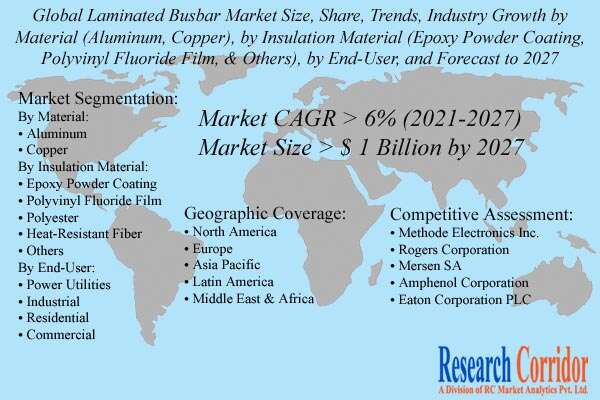
The global laminated busbar market size is anticipated to register a significant CAGR of over 6% during the forecast period and estimated to reach over USD 1 billion by 2027. The rapid growth in industrialization coupled with the growing power consumption is a prominent factor to drive the market growth. Furthermore, the increasing adoption of energy-efficient systems and the growth in green energy sources is further anticipated to fuel the market growth over the forecast period. The increasing use of renewable energy sources, stringent government regulations, and the increase in smart city projects are anticipated to boost the market.
Market Drivers:
Increasing Demand for Power Generation and Distribution: The growing demand for electricity, driven by population growth, urbanization, and industrialization, fuels the need for efficient power generation and distribution systems. Laminated busbars are widely used in power distribution applications to enhance electrical conductivity, reduce power losses, and improve system efficiency. The increasing demand for power infrastructure drives the growth of the laminated busbar market.
Renewable Energy Integration: The integration of renewable energy sources, such as solar and wind power, into the power grid requires efficient power transmission and distribution solutions. Laminated busbars offer advantages such as compactness, flexibility, and high current-carrying capacity, making them suitable for renewable energy systems. The transition towards clean energy and the increasing installation of renewable energy projects contribute to the demand for laminated busbars.
Growing Industrialization and Infrastructure Development: Industrialization and infrastructure development projects, particularly in sectors like manufacturing, data centers, transportation, and commercial buildings, drive the demand for laminated busbars. These projects require efficient power distribution solutions to handle high power loads, and laminated busbars provide compact and reliable solutions for these applications.
Increasing Focus on Energy Efficiency: Energy efficiency has become a crucial consideration in various industries. Laminated busbars offer lower resistance and reduced power losses compared to traditional busbar systems, contributing to improved energy efficiency. As industries and businesses aim to minimize energy consumption and optimize their operations, the demand for energy-efficient solutions like laminated busbars increases.
Electrification of Transportation: The growing trend towards electric vehicles (EVs) and the electrification of transportation systems create opportunities for the laminated busbar market. Laminated busbars are used in charging infrastructure, battery management systems, and onboard electrical systems of EVs. As the adoption of EVs continues to rise, the demand for laminated busbars in the transportation sector increases.
Focus on Miniaturization and Space Optimization: The need for compact and space-saving solutions is driving the demand for laminated busbars. As industries strive to optimize the use of space in various applications, such as power electronics, automotive, and consumer electronics, laminated busbars offer advantages with their reduced footprint, improved thermal management, and increased power density.
Technological Advancements and Innovation: Continuous technological advancements and innovation in laminated busbar design and manufacturing techniques contribute to market growth. The development of advanced materials, improved insulation properties, and enhanced manufacturing processes enable the production of laminated busbars with higher performance, reliability, and cost-effectiveness.
Stringent Electrical Safety Standards: Compliance with electrical safety standards and regulations is of utmost importance in many industries. Laminated busbars offer inherent safety features, such as insulation between conductors and protection against electrical arcing and short circuits. The adoption of laminated busbars helps industries meet safety requirements, avoid potential hazards, and ensure reliable operation of electrical systems.
Increasing Focus on Renewable and Sustainable Materials: The industry’s growing emphasis on sustainability and the use of renewable and environmentally friendly materials also drives the laminated busbar market. Manufacturers are increasingly adopting sustainable materials for laminated busbars, such as recyclable metals and eco-friendly insulating materials, aligning with the broader sustainability goals of industries.
Growing Demand in Emerging Economies: The laminated busbar market is witnessing significant growth in emerging economies. Rapid industrialization, infrastructure development, and increasing investments in power generation and distribution infrastructure in countries such as China, India, and Brazil contribute to the demand for laminated busbars in these regions.
Market Snapshot:
| Benchmark Year | 2022 | ||
| Market Size | > USD 1 Billion by 2027 | ||
| Market Growth (CAGR) | > 6% (2023-2030) | ||
| Largest Market Share | lock | ||
| Analysis Period | 2020-2030 | ||
| Market Players | Methode Electronics Inc., Rogers Corporation, Mersen SA, Sun.King Power Electronics Group Ltd., and Amphenol Corporation |
Market Insights:
The global laminated busbar market is bifurcated into the material, insulation material, end-user, and geography. On the basis of insulation material, the market is further segmented into epoxy powder coating, polyvinyl fluoride film, and others. The epoxy powder coating segment dominated the global market in 2020 and accounted to hold the largest revenue share of over 40% of the market by the end of the analysis period. The wide use of the product in motor drive and switchgear applications is one of the prominent factor to drive the segment growth.
On the basis of end-user, the global laminated busbar market is segmented into power utilities, industrial, residential and commercial. The power utilities segment is expected to hold the largest revenue share of the market by the end of the analysis period. The growing investment in renewable energy and the expansion of power distribution infrastructure is further expected to fuel the segment growth over the forecast period. Furthermore, growing demand for clean energy and focus on energy efficiency is expected to drive the segment growth.
To know more about the report, request sample papers
The laminated busbar comprehensive study analyzes industry trends, market size, competitive analysis, and market forecast – 2021 to 2027. Research Corridor report provides detailed premium insight into the global market and reveals the potential revenue streams, commercial prospects, market drivers, challenges, opportunities, issues, and events affecting the industry. In addition, the report has a dedicated section covering market forecasts and analysis for leading geographies, profiles of major companies operating in the market and expert opinion obtained from interviews with industry executives and experts from prominent companies.
The laminated busbar market research report presents the analysis of each segment from 2018 to 2027 considering 2020 as the base year for the research. The compounded annual growth rate (CAGR) for each respective segment is calculated for the forecast period from 2021 to 2027.
Historical & Forecast Period
- 2018-19 – Historical Year
- 2020 – Base Year
- 2021-2027 – Forecast Period
Market Segmentation:
By Material:
- Aluminum
- Copper
By Insulation Material:
- Epoxy Powder Coating
- Polyvinyl Fluoride Film
- Polyester
- Heat-Resistant Fiber
- Others
By End-User:
- Power Utilities
- Industrial
- Residential
- Commercial
By Region:
- North America
- Europe
- Asia Pacific
- Latin America
- Middle East & Africa
Geographic Coverage
Geographically, the laminated busbar market report comprises dedicated sections centering on the regional market revenue and trends. The laminated busbar market has been segmented on the basis of geographic regions into North America, Europe, Asia Pacific, and Rest of the World (RoW). The RoW segment consists of Latin America and the Middle East & Africa. The laminated busbar market has been extensively analyzed on the basis of various regional factors such as demographics, gross domestic product (GDP), inflation rate, acceptance, and others. Laminated busbar market estimates have also been provided for the historical years 2018 & 2019 along with forecasts for the period from 2021 – 2027.
Competitive Assessment
Some of the major market players operating in the global laminated busbar market are Methode Electronics Inc., Rogers Corporation, Mersen SA, Sun.King Power Electronics Group Ltd., and Amphenol Corporation. Companies are exploring markets through expansion, new investment, the introduction of new services, and collaboration as their preferred strategies. Players are exploring new geography through expansion and acquisition to gain a competitive advantage through joint synergy.
Key Companies:
- Methode Electronics Inc.
- Rogers Corporation
- Mersen SA
- Sun.King Power Electronics Group Ltd.
- Amphenol Corporation
- Eaton Corporation PLC
- Ryoden Kasei Co.,Ltd.
- Molex, LLC
- Electronic Systems Packaging LLC
- Raychem RPG Private Limited
Key Questions Answered by Laminated Busbar Market Report
- Global laminated busbar market forecasts from 2021-2027
- Regional laminated busbar market forecasts from 2021-2027 covering Asia-Pacific, North America, Europe, Middle East & Africa, and Latin America
- Country-level forecasts from 2021-2027 covering 15 major countries from the regions as mentioned above
- Laminated busbar submarket forecasts from 2021-2027 covering the market by material, by insulation material, by end-user, and geography
- Various industry models such as SWOT analysis, Value Chain Analysis about laminated busbar market
- Analysis of the key factors driving and restraining the growth of the global, regional, and country-level laminated busbar markets from 2021-2027
- Competitive Landscape and market positioning of top 10 players operating in the laminated busbar market
1. Preface
1.1. Report Description
1.1.1. Purpose of the Report
1.1.2. Target Audience
1.1.3. USP and Key Offerings
1.2. Research Scope
1.3. Research Methodology
1.3.1. Phase I – Secondary Research
1.3.2. Phase II – Primary Research
1.3.3. Phase III – Expert Panel Review
1.4. Assumptions
2. Executive Summary
2.1. Global Laminated Busbar Market Portraiture
2.2. Global Laminated Busbar Market, by Material, 2020 (USD Mn)
2.3. Global Laminated Busbar Market, by Insulation Material, 2020 (USD Mn)
2.4. Global Laminated Busbar Market, by End-User, 2020 (USD Mn)
2.5. Global Laminated Busbar Market, by Geography, 2020 (USD Mn)
3. Global Laminated Busbar Market Analysis
3.1. Laminated Busbar Market Overview
3.2. Market Inclination Insights
3.3. Market Dynamics
3.3.1. Drivers
3.3.2. Challenges
3.3.3. Opportunities
3.4. Attractive Investment Proposition
3.5. Competitive Analysis
3.6. Porter’s Five Force Analysis
3.6.1. Bargaining Power of Suppliers
3.6.2. Bargaining Power of Buyers
3.6.3. Threat of New Entrants
3.6.4. Threat of Substitutes
3.6.5. Degree of Competition
3.7. COVID-19 Impact Analysis
4. Global Laminated Busbar Market By Material, 2018 – 2027 (USD Mn)
4.1. Overview
4.2. Aluminum
4.3. Copper
5. Global Laminated Busbar Market By Insulation Material, 2018 – 2027 (USD Mn)
5.1. Overview
5.2. Epoxy Powder Coating
5.3. Polyvinyl Fluoride Film
5.4. Polyester
5.5. Heat-Resistant Fiber
5.6. Others
6. Global Laminated Busbar Market By End-User, 2018 – 2027 (USD Mn)
6.1. Overview
6.2. Power Utilities
6.3. Industrial
6.4. Residential
6.5. Commercial
7. North America Laminated Busbar Market Analysis and Forecast, 2018 – 2027 (USD Mn)
7.1.1. Overview
7.1.2. North America Laminated Busbar Market by Material (2018-2027 USD Mn)
7.1.3. North America Laminated Busbar Market by Insulation Material (2018-2027 USD Mn)
7.1.4. North America Laminated Busbar Market by End-User (2018-2027 USD Mn)
7.1.5. North America Laminated Busbar Market by Country (2018-2027 USD Mn)
7.1.5.1. U.S.
7.1.5.1.1. U.S. Laminated Busbar Market by Material (2018-2027 USD Mn)
7.1.5.1.2. U.S. Laminated Busbar Market by Insulation Material (2018-2027 USD Mn)
7.1.5.1.3. U.S. Laminated Busbar Market by End-User (2018-2027 USD Mn)
7.1.5.2. Canada
7.1.5.2.1. Canada Laminated Busbar Market by Material (2018-2027 USD Mn)
7.1.5.2.2. Canada Laminated Busbar Market by Insulation Material (2018-2027 USD Mn)
7.1.5.2.3. Canada Laminated Busbar Market by End-User (2018-2027 USD Mn)
8. Europe Laminated Busbar Market Analysis and Forecast, 2018 – 2027 (USD Mn)
8.1.1. Overview
8.1.2. Europe Laminated Busbar Market by Material (2018-2027 USD Mn)
8.1.3. Europe Laminated Busbar Market by Insulation Material (2018-2027 USD Mn)
8.1.4. Europe Laminated Busbar Market by End-User (2018-2027 USD Mn)
8.1.5. Europe Laminated Busbar Market by Country (2018-2027 USD Mn)
8.1.5.1. Germany
8.1.5.1.1. Germany Laminated Busbar Market by Material (2018-2027 USD Mn)
8.1.5.1.2. Germany Laminated Busbar Market by Insulation Material (2018-2027 USD Mn)
8.1.5.1.3. Germany Laminated Busbar Market by End-User (2018-2027 USD Mn)
8.1.5.2. U.K.
8.1.5.2.1. U.K. Laminated Busbar Market by Material (2018-2027 USD Mn)
8.1.5.2.2. U.K. Laminated Busbar Market by Insulation Material (2018-2027 USD Mn)
8.1.5.2.3. U.K. Laminated Busbar Market by End-User (2018-2027 USD Mn)
8.1.5.3. France
8.1.5.3.1. France Laminated Busbar Market by Material (2018-2027 USD Mn)
8.1.5.3.2. France Laminated Busbar Market by Insulation Material (2018-2027 USD Mn)
8.1.5.3.3. France Laminated Busbar Market by End-User (2018-2027 USD Mn)
8.1.5.4. Italy
8.1.5.4.1. Italy Laminated Busbar Market by Material (2018-2027 USD Mn)
8.1.5.4.2. Italy Laminated Busbar Market by Insulation Material (2018-2027 USD Mn)
8.1.5.4.3. Italy Laminated Busbar Market by End-User (2018-2027 USD Mn)
8.1.5.5. Rest of Europe
8.1.5.5.1. Rest of Europe Laminated Busbar Market by Material (2018-2027 USD Mn)
8.1.5.5.2. Rest of Europe Laminated Busbar Market by Insulation Material (2018-2027 USD Mn)
8.1.5.5.3. Rest of Europe Laminated Busbar Market by End-User (2018-2027 USD Mn)
9. Asia Pacific Laminated Busbar Market Analysis and Forecast, 2018 – 2027 (USD Mn)
9.1.1. Overview
9.1.2. Asia Pacific Laminated Busbar Market by Material (2018-2027 USD Mn)
9.1.3. Asia Pacific Laminated Busbar Market by Insulation Material (2018-2027 USD Mn)
9.1.4. Asia Pacific Laminated Busbar Market by End-User (2018-2027 USD Mn)
9.1.5. Asia Pacific Laminated Busbar Market by Country (2018-2027 USD Mn)
9.1.5.1. China
9.1.5.1.1. China Laminated Busbar Market by Material (2018-2027 USD Mn)
9.1.5.1.2. China Laminated Busbar Market by Insulation Material (2018-2027 USD Mn)
9.1.5.1.3. China Laminated Busbar Market by End-User (2018-2027 USD Mn)
9.1.5.2. Japan
9.1.5.2.1. Japan Laminated Busbar Market by Material (2018-2027 USD Mn)
9.1.5.2.2. Japan Laminated Busbar Market by Insulation Material (2018-2027 USD Mn)
9.1.5.2.3. Japan Laminated Busbar Market by End-User (2018-2027 USD Mn)
9.1.5.3. Rest of Asia Pacific
9.1.5.3.1. Rest of Asia Pacific Laminated Busbar Market by Material (2018-2027 USD Mn)
9.1.5.3.2. Rest of Asia Pacific Laminated Busbar Market by Insulation Material (2018-2027 USD Mn)
9.1.5.3.3. Rest of Asia Pacific Laminated Busbar Market by End-User (2018-2027 USD Mn)
10. Latin America (LATAM) Laminated Busbar Market Analysis and Forecast, 2018 – 2027 (USD Mn)
10.1.1. Overview
10.1.2. Latin America Laminated Busbar Market by Material (2018-2027 USD Mn)
10.1.3. Latin America Laminated Busbar Market by Insulation Material (2018-2027 USD Mn)
10.1.4. Latin America Laminated Busbar Market by End-User (2018-2027 USD Mn)
10.1.5. Latin America Laminated Busbar Market by Country (2018-2027 USD Mn)
10.1.5.1. Brazil
10.1.5.1.1. Brazil Laminated Busbar Market by Material (2018-2027 USD Mn)
10.1.5.1.2. Brazil Laminated Busbar Market by Insulation Material (2018-2027 USD Mn)
10.1.5.1.3. Brazil Laminated Busbar Market by End-User (2018-2027 USD Mn)
10.1.5.2. Mexico
10.1.5.2.1. Mexico Laminated Busbar Market by Material (2018-2027 USD Mn)
10.1.5.2.2. Mexico Laminated Busbar Market by Insulation Material (2018-2027 USD Mn)
10.1.5.2.3. Mexico Laminated Busbar Market by End-User (2018-2027 USD Mn)
10.1.5.3. Rest of Latin America
10.1.5.3.1. Rest of Latin America Laminated Busbar Market by Material (2018-2027 USD Mn)
10.1.5.3.2. Rest of Latin America Laminated Busbar Market by Insulation Material (2018-2027 USD Mn)
10.1.5.3.3. Rest of Latin America Laminated Busbar Market by End-User (2018-2027 USD Mn)
11. Middle East and Africa Laminated Busbar Market Analysis and Forecast, 2018 – 2027 (USD Mn)
11.1.1. Overview
11.1.2. MEA Laminated Busbar Market by Material (2018-2027 USD Mn)
11.1.3. MEA Laminated Busbar Market by Insulation Material (2018-2027 USD Mn)
11.1.4. MEA Laminated Busbar Market by End-User (2018-2027 USD Mn)
11.1.5. Middle East and Africa Laminated Busbar Market, by Country (2018-2027 USD Mn)
11.1.5.1. GCC
11.1.5.1.1. GCC Laminated Busbar Market by Material (2018-2027 USD Mn)
11.1.5.1.2. GCC Laminated Busbar Market by Insulation Material (2018-2027 USD Mn)
11.1.5.1.3. GCC Laminated Busbar Market by End-User (2018-2027 USD Mn)
11.1.5.2. South Africa
11.1.5.2.1. South Africa Laminated Busbar Market by Material (2018-2027 USD Mn)
11.1.5.2.2. South Africa Laminated Busbar Market by Insulation Material (2018-2027 USD Mn)
11.1.5.2.3. South Africa Laminated Busbar Market by End-User (2018-2027 USD Mn)
11.1.5.3. Rest of MEA
11.1.5.3.1. Rest of MEA Laminated Busbar Market by Material (2018-2027 USD Mn)
11.1.5.3.2. Rest of MEA Laminated Busbar Market by Insulation Material (2018-2027 USD Mn)
11.1.5.3.3. Rest of MEA Laminated Busbar Market by End-User (2018-2027 USD Mn)
12. Company Profiles
12.1. Methode Electronics Inc.
12.1.1. Business Description
12.1.2. Financial Health and Budget Allocation
12.1.3. Product Positions/Portfolio
12.1.4. Recent Development
12.1.5. SWOT Analysis
12.2. Rogers Corporation
12.2.1. Business Description
12.2.2. Financial Health and Budget Allocation
12.2.3. Product Positions/Portfolio
12.2.4. Recent Development
12.2.5. SWOT Analysis
12.3. Mersen SA
12.3.1. Business Description
12.3.2. Financial Health and Budget Allocation
12.3.3. Product Positions/Portfolio
12.3.4. Recent Development
12.3.5. SWOT Analysis
12.4. Sun.King Power Electronics Group Ltd.
12.4.1. Business Description
12.4.2. Financial Health and Budget Allocation
12.4.3. Product Positions/Portfolio
12.4.4. Recent Development
12.4.5. SWOT Analysis
12.5. Amphenol Corporation
12.5.1. Business Description
12.5.2. Financial Health and Budget Allocation
12.5.3. Product Positions/Portfolio
12.5.4. Recent Development
12.5.5. SWOT Analysis
12.6. Eaton Corporation PLC
12.6.1. Business Description
12.6.2. Financial Health and Budget Allocation
12.6.3. Product Positions/Portfolio
12.6.4. Recent Development
12.6.5. SWOT Analysis
12.7. Ryoden Kasei Co.,Ltd.
12.7.1. Business Description
12.7.2. Financial Health and Budget Allocation
12.7.3. Product Positions/Portfolio
12.7.4. Recent Development
12.7.5. SWOT Analysis
12.8. Molex, LLC
12.8.1. Business Description
12.8.2. Financial Health and Budget Allocation
12.8.3. Product Positions/Portfolio
12.8.4. Recent Development
12.8.5. SWOT Analysis
12.9. Electronic Systems Packaging LLC
12.9.1. Business Description
12.9.2. Financial Health and Budget Allocation
12.9.3. Product Positions/Portfolio
12.9.4. Recent Development
12.9.5. SWOT Analysis
12.10. Raychem RPG Private Limited
12.10.1. Business Description
12.10.2. Financial Health and Budget Allocation
12.10.3. Product Positions/Portfolio
12.10.4. Recent Development
12.10.5. SWOT Analysis
$ 3600/- Single User License
$ 5200/- Multi User License

We understand that every business has unique requirements. This report can be customized based on:
- Deep regional & country-level market intelligence
- Application-specific and end-use industry segmentation
- Competitive landscape & strategic benchmarking
- Go-to-market and expansion strategy insights
- Custom data cuts aligned to your business goals
- Structured Primary Research Framework
- On-Demand Industry Expert Interviews Available
- Dedicated Analyst Support
- Custom Data On Request
- Post-Purchase Strategy Consultation
- Complimentary 30-min Analyst Session
- 30% of Our Clients Are Returning Enterprise Buyers
Our Clients