The global polyalphaolefin market size is projected to grow at a significant CAGR of around 3% during the forecast period 2022 to 2028. The increasing use of polyalphaolefin in various applications such as lubricants, industrial oil, engine oils, and others is a primary factor to drive the market growth. Furthermore, the growing applications of POA in the automotive industry is further anticipated to boost the market growth over the forecast period. Moreover, the rapid growth in industrialization, growing automotive industries, and the increasing offshore drilling activities in developing economies are projected to propel the market growth in the next upcoming years.
Market Drivers:
Growing Automotive Industry: PAO is widely used as a base oil in automotive lubricants and fluids. The automotive industry’s growth, driven by factors such as population growth, urbanization, and increasing vehicle sales, fuels the demand for PAO. Additionally, the demand for high-performance lubricants with better thermal stability, oxidation resistance, and low-temperature fluidity further drives the market for PAO.
Industrial Growth and Machinery Applications: PAO finds applications in various industrial sectors, including machinery, equipment, and manufacturing. The growth and development of industries such as manufacturing, construction, and heavy machinery drive the demand for lubricants and fluids containing PAO. PAO’s high viscosity index, excellent lubricating properties, and thermal stability make it suitable for demanding industrial applications.
Increasing Demand for Synthetic Lubricants: Synthetic lubricants, including those based on PAO, offer superior performance compared to conventional mineral-based lubricants. Synthetic lubricants provide enhanced viscosity control, better oxidative stability, improved wear protection, and extended equipment life. The growing demand for synthetic lubricants in various industries, including automotive, industrial, and aerospace, drives the demand for PAO.
Shift towards Energy Efficiency: Energy efficiency has become a key focus across industries due to environmental concerns and regulations. PAO-based lubricants offer reduced friction and improved energy efficiency compared to conventional lubricants. Industries are increasingly adopting energy-efficient solutions, driving the demand for PAO in lubricants.
Technological Advancements in PAO Production: Continuous advancements in PAO production technologies, such as metallocene catalysts and hydroformylation processes, have led to the development of high-quality PAO with improved properties. These advancements enable manufacturers to produce PAO with enhanced viscosity, oxidation resistance, and thermal stability, thereby driving the market for PAO.
Growth of the Aerospace Industry: PAO is used in various applications in the aerospace industry, including hydraulic fluids, gear oils, and turbine oils. The aerospace industry’s growth, driven by factors such as increasing air travel, aircraft production, and defense spending, contributes to the demand for PAO-based lubricants and fluids.
Regulatory Support and Environmental Considerations: Environmental regulations promoting the use of environmentally friendly lubricants and fluids have influenced the market for PAO. PAO-based lubricants are considered environmentally friendly due to their low toxicity, biodegradability, and reduced emissions. Regulatory support and environmental considerations drive the adoption of PAO in lubricant formulations.
Expansion in Emerging Economies: The market for PAO is witnessing significant growth in emerging economies, particularly in Asia Pacific. Factors such as rapid industrialization, urbanization, and increased manufacturing activities in these regions contribute to the expansion of the market. The growing automotive and industrial sectors in emerging economies drive the demand for PAO.
Market Snapshot:
| Benchmark Year | 2022 | ||
| Market Size | lock | ||
| Market Growth (CAGR) | ~ 3% (2023-2030) | ||
| Largest Market Share | lock | ||
| Analysis Period | 2020-2030 | ||
| Market Players | Shell Chemical Ltd., Mitsui Chemicals, Inc., Idemitsu Kosan Co., Ltd., Lubricon Industries, and Shanghai Fox Chemical Technology Co., Ltd. |
Market Insights:
The global polyalphaolefin market is bifurcated into type, application, end-user, and geography. On the basis of type, the market is further segmented into low viscosity, medium viscosity, and high viscosity polyalphaolefin. The low viscosity POA segment dominated the global market in 2021 and is expected to maintain its dominance over the forecast period. The widespread use of the product in various applications such as lubricants, engine oils, and other applications is one of the prominent factor to drive the segment growth. Furthermore, the increasing demand for low viscosity POA in automotive and industrial applications is further expected to fuel the segment growth over the forecast period.
On the basis of applications, the global polyalphaolefin market is segmented into lubricant, industrial oil, hydraulic fluids, greases, engine oil, and others. The engine oil segment is expected to hold the largest revenue share of the market by the end of the analysis period. Its ability to lubricate at both ends of the temperature spectrum is a major factor to drive the segment growth. Furthermore, the properties associated with the product such as hydrolytic stability, lower pour point, and higher viscosity index is expected to increase the demand for the product in gear oil, which is expected to fuel the market growth in gear oil application.
To know more about the study, request sample papers
The polyalphaolefin comprehensive study analyzes industry trends, market size, competitive analysis, and market forecast – 2022 to 2028. Research Corridor report provides detailed premium insight into the global market and reveals the potential revenue streams, commercial prospects, market drivers, challenges, opportunities, issues, and events affecting the industry. In addition, the report has a dedicated section covering market forecasts and analysis for leading geographies, profiles of major companies operating in the market, and expert opinions obtained from interviews with industry executives and experts from prominent companies.
The polyalphaolefin market research report presents the analysis of each segment from 2019 to 2028 considering 2020 as the base year for the research. The compounded annual growth rate (CAGR) for each respective segment is calculated for the forecast period from 2021 to 2027.
Historical & Forecast Period
- 2019-20 – Historical Year
- 2021 – Base Year
- 2022-2028 – Forecast Period
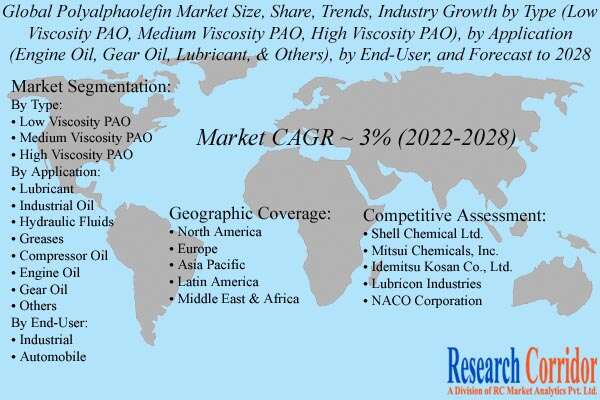
Market Segmentation:
By Type:
- Low Viscosity Polyalphaolefin (PAO)
- Medium Viscosity Polyalphaolefin (PAO)
- High Viscosity Polyalphaolefin (PAO)
By Application:
- Lubricant
- Industrial Oil
- Hydraulic Fluids
- Greases
- Compressor Oil
- Engine Oil
- Gear Oil
- Others
By End-User:
- Industrial
- Automobile
By Region:
- North America
- Europe
- Asia Pacific
- Latin America
- Middle East & Africa
Regional Analysis:
Geographically, the polyalphaolefin market report comprises dedicated sections centering on the regional market revenue and trends. The polyalphaolefin market has been segmented on the basis of geographic regions into North America, Europe, Asia Pacific, and the Rest of the World (RoW). The RoW segment consists of Latin America and the Middle East & Africa. The polyalphaolefin market has been extensively analyzed on the basis of various regional factors such as demographics, gross domestic product (GDP), inflation rate, acceptance, and others. Polyalphaolefin market estimates have also been provided for the historical years 2018 & 2019 along with forecasts for the period from 2022 – 2028.
Competitive Assessment:
Some of the major market players operating in the global polyalphaolefin market are Shell Chemical Ltd., Mitsui Chemicals, Inc., Idemitsu Kosan Co., Ltd., Lubricon Industries, and Shanghai Fox Chemical Technology Co., Ltd. Companies are exploring markets by expansion, new investment, the introduction of new services, and collaboration as their preferred strategies. Players are exploring new geography through expansion and acquisition to gain a competitive advantage through joint synergy.
Key Companies:
- Shell Chemical Ltd.
- Mitsui Chemicals, Inc.
- Idemitsu Kosan Co., Ltd.
- Lubricon Industries
- Shanghai Fox Chemical Technology Co., Ltd.
- NACO Corporation
- Chemtura Corporation
- INEOS Oligomers
- Tulstar Products, Inc.
- Chevron Phillips Chemical Company LLC
Key Questions Answered by Polyalphaolefin Market Report
- Global polyalphaolefin market forecasts from 2022-2028
- Regional market forecasts from 2022-2028 covering Asia-Pacific, North America, Europe, Middle East & Africa, and Latin America
- Country-level forecasts from 2022-2028 covering 15 major countries from the regions as mentioned above
- Polyalphaolefin submarket forecasts from 2022-2028 covering the market by type, by application, by end-user, and geography
- Various industry models such as SWOT analysis, Value Chain Analysis about the market
- Analysis of the key factors driving and restraining the growth of the global, regional, and country-level polyalphaolefin markets from 2022-2028
- Competitive Landscape and market positioning of top 10 players operating in the market
1. Preface
1.1. Report Description
1.1.1. Purpose of the Report
1.1.2. Target Audience
1.1.3. USP and Key Offerings
1.2. Research Scope
1.3. Research Methodology
1.3.1. Phase I – Secondary Research
1.3.2. Phase II – Primary Research
1.3.3. Phase III – Expert Panel Review
1.4. Assumptions
2. Executive Summary
2.1. Global Polyalphaolefin Market Portraiture
2.2. Global Polyalphaolefin Market, by Type, 2021 (USD Mn)
2.3. Global Polyalphaolefin Market, by Application, 2021 (USD Mn)
2.4. Global Polyalphaolefin Market, by End-User, 2021 (USD Mn)
2.5. Global Polyalphaolefin Market, by Geography, 2021 (USD Mn)
3. Global Polyalphaolefin Market Analysis
3.1. Polyalphaolefin Market Overview
3.2. Market Inclination Insights
3.3. Market Dynamics
3.3.1. Drivers
3.3.2. Challenges
3.3.3. Opportunities
3.4. Attractive Investment Proposition
3.5. Competitive Analysis
3.6. Porter’s Five Force Analysis
3.6.1. Bargaining Power of Suppliers
3.6.2. Bargaining Power of Buyers
3.6.3. Threat of New Entrants
3.6.4. Threat of Substitutes
3.6.5. Degree of Competition
3.7. COVID-19 Impact Analysis
4. Global Polyalphaolefin Market By Type, 2019 – 2028 (USD Mn)
4.1. Overview
4.2. Low Viscosity Polyalphaolefin (PAO)
4.3. Medium Viscosity Polyalphaolefin (PAO)
4.4. High Viscosity Polyalphaolefin (PAO)
5. Global Polyalphaolefin Market By Application, 2019 – 2028 (USD Mn)
5.1. Overview
5.2. Lubricant
5.3. Industrial Oil
5.4. Hydraulic Fluids
5.5. Greases
5.6. Compressor Oil
5.7. Engine Oil
5.8. Gear Oil
5.9. Others
6. Global Polyalphaolefin Market By End-User, 2019 – 2028 (USD Mn)
6.1. Overview
6.2. Industrial
6.3. Automobile
7. North America Polyalphaolefin Market Analysis and Forecast, 2019 – 2028 (USD Mn)
7.1. Overview
7.2. North America Polyalphaolefin Market by Type (2019-2028 USD Mn)
7.3. North America Polyalphaolefin Market by Application (2019-2028 USD Mn)
7.4. North America Polyalphaolefin Market by End-User (2019-2028 USD Mn)
7.5. North America Polyalphaolefin Market by Country (2019-2028 USD Mn)
7.5.1. U.S.
7.5.1.1. U.S. Polyalphaolefin Market by Type (2019-2028 USD Mn)
7.5.1.2. U.S. Polyalphaolefin Market by Application (2019-2028 USD Mn)
7.5.1.3. U.S. Polyalphaolefin Market by End-User (2019-2028 USD Mn)
7.5.2. Canada
7.5.2.1. Canada Polyalphaolefin Market by Type (2019-2028 USD Mn)
7.5.2.2. Canada Polyalphaolefin Market by Application (2019-2028 USD Mn)
7.5.2.3. Canada Polyalphaolefin Market by End-User (2019-2028 USD Mn)
8. Europe Polyalphaolefin Market Analysis and Forecast, 2019 – 2028 (USD Mn)
8.1. Overview
8.2. Europe Polyalphaolefin Market by Type (2019-2028 USD Mn)
8.3. Europe Polyalphaolefin Market by Application (2019-2028 USD Mn)
8.4. Europe Polyalphaolefin Market by End-User (2019-2028 USD Mn)
8.5. Europe Polyalphaolefin Market by Country (2019-2028 USD Mn)
8.5.1. Germany
8.5.1.1. Germany Polyalphaolefin Market by Type (2019-2028 USD Mn)
8.5.1.2. Germany Polyalphaolefin Market by Application (2019-2028 USD Mn)
8.5.1.3. Germany Polyalphaolefin Market by End-User (2019-2028 USD Mn)
8.5.2. U.K.
8.5.2.1. U.K. Polyalphaolefin Market by Type (2019-2028 USD Mn)
8.5.2.2. U.K. Polyalphaolefin Market by Application (2019-2028 USD Mn)
8.5.2.3. U.K. Polyalphaolefin Market by End-User (2019-2028 USD Mn)
8.5.3. France
8.5.3.1. France Polyalphaolefin Market by Type (2019-2028 USD Mn)
8.5.3.2. France Polyalphaolefin Market by Application (2019-2028 USD Mn)
8.5.3.3. France Polyalphaolefin Market by End-User (2019-2028 USD Mn)
8.5.4. Italy
8.5.4.1. Italy Polyalphaolefin Market by Type (2019-2028 USD Mn)
8.5.4.2. Italy Polyalphaolefin Market by Application (2019-2028 USD Mn)
8.5.4.3. Italy Polyalphaolefin Market by End-User (2019-2028 USD Mn)
8.5.5. Rest of Europe
8.5.5.1. Rest of Europe Polyalphaolefin Market by Type (2019-2028 USD Mn)
8.5.5.2. Rest of Europe Polyalphaolefin Market by Application (2019-2028 USD Mn)
8.5.5.3. Rest of Europe Polyalphaolefin Market by End-User (2019-2028 USD Mn)
9. Asia Pacific Polyalphaolefin Market Analysis and Forecast, 2019 – 2028 (USD Mn)
9.1. Overview
9.2. Asia Pacific Polyalphaolefin Market by Type (2019-2028 USD Mn)
9.3. Asia Pacific Polyalphaolefin Market by Application (2019-2028 USD Mn)
9.4. Asia Pacific Polyalphaolefin Market by End-User (2019-2028 USD Mn)
9.5. Asia Pacific Polyalphaolefin Market by Country (2019-2028 USD Mn)
9.5.1. China
9.5.1.1. China Polyalphaolefin Market by Type (2019-2028 USD Mn)
9.5.1.2. China Polyalphaolefin Market by Application (2019-2028 USD Mn)
9.5.1.3. China Polyalphaolefin Market by End-User (2019-2028 USD Mn)
9.5.2. Japan
9.5.2.1. Japan Polyalphaolefin Market by Type (2019-2028 USD Mn)
9.5.2.2. Japan Polyalphaolefin Market by Application (2019-2028 USD Mn)
9.5.2.3. Japan Polyalphaolefin Market by End-User (2019-2028 USD Mn)
9.5.3. Rest of Asia Pacific
9.5.3.1. Rest of Asia Pacific Polyalphaolefin Market by Type (2019-2028 USD Mn)
9.5.3.2. Rest of Asia Pacific Polyalphaolefin Market by Application (2019-2028 USD Mn)
9.5.3.3. Rest of Asia Pacific Polyalphaolefin Market by End-User (2019-2028 USD Mn)
10. Latin America (LATAM) Polyalphaolefin Market Analysis and Forecast, 2019 – 2028 (USD Mn)
10.1. Overview
10.2. Latin America Polyalphaolefin Market by Type (2019-2028 USD Mn)
10.3. Latin America Polyalphaolefin Market by Application (2019-2028 USD Mn)
10.4. Latin America Polyalphaolefin Market by End-User (2019-2028 USD Mn)
10.5. Latin America Polyalphaolefin Market by Country (2019-2028 USD Mn)
10.5.1. Brazil
10.5.1.1. Brazil Polyalphaolefin Market by Type (2019-2028 USD Mn)
10.5.1.2. Brazil Polyalphaolefin Market by Application (2019-2028 USD Mn)
10.5.1.3. Brazil Polyalphaolefin Market by End-User (2019-2028 USD Mn)
10.5.2. Mexico
10.5.2.1. Mexico Polyalphaolefin Market by Type (2019-2028 USD Mn)
10.5.2.2. Mexico Polyalphaolefin Market by Application (2019-2028 USD Mn)
10.5.2.3. Mexico Polyalphaolefin Market by End-User (2019-2028 USD Mn)
10.5.3. Rest of Latin America
10.5.3.1. Rest of Latin America Polyalphaolefin Market by Type (2019-2028 USD Mn)
10.5.3.2. Rest of Latin America Polyalphaolefin Market by Application (2019-2028 USD Mn)
10.5.3.3. Rest of Latin America Polyalphaolefin Market by End-User (2019-2028 USD Mn)
11. Middle East and Africa Polyalphaolefin Market Analysis and Forecast, 2019 – 2028 (USD Mn)
11.1. Overview
11.2. MEA Polyalphaolefin Market by Type (2019-2028 USD Mn)
11.3. MEA Polyalphaolefin Market by Application (2019-2028 USD Mn)
11.4. MEA Polyalphaolefin Market by End-User (2019-2028 USD Mn)
11.5. Middle East and Africa Polyalphaolefin Market, by Country (2019-2028 USD Mn)
11.5.1. GCC
11.5.1.1. GCC Polyalphaolefin Market by Type (2019-2028 USD Mn)
11.5.1.2. GCC Polyalphaolefin Market by Application (2019-2028 USD Mn)
11.5.1.3. GCC Polyalphaolefin Market by End-User (2019-2028 USD Mn)
11.5.2. South Africa
11.5.2.1. South Africa Polyalphaolefin Market by Type (2019-2028 USD Mn)
11.5.2.2. South Africa Polyalphaolefin Market by Application (2019-2028 USD Mn)
11.5.2.3. South Africa Polyalphaolefin Market by End-User (2019-2028 USD Mn)
11.5.3. Rest of MEA
11.5.3.1. Rest of MEA Polyalphaolefin Market by Type (2019-2028 USD Mn)
11.5.3.2. Rest of MEA Polyalphaolefin Market by Application (2019-2028 USD Mn)
11.5.3.3. Rest of MEA Polyalphaolefin Market by End-User (2019-2028 USD Mn)
12. Company Profiles
12.1. Shell Chemical Ltd.
12.1.1. Business Description
12.1.2. Financial Health and Budget Allocation
12.1.3. Product Positions/Portfolio
12.1.4. Recent Development
12.1.5. SWOT Analysis
12.2. Mitsui Chemicals, Inc.
12.2.1. Business Description
12.2.2. Financial Health and Budget Allocation
12.2.3. Product Positions/Portfolio
12.2.4. Recent Development
12.2.5. SWOT Analysis
12.3. Idemitsu Kosan Co., Ltd.
12.3.1. Business Description
12.3.2. Financial Health and Budget Allocation
12.3.3. Product Positions/Portfolio
12.3.4. Recent Development
12.3.5. SWOT Analysis
12.4. Lubricon Industries
12.4.1. Business Description
12.4.2. Financial Health and Budget Allocation
12.4.3. Product Positions/Portfolio
12.4.4. Recent Development
12.4.5. SWOT Analysis
12.5. Shanghai Fox Chemical Technology Co., Ltd.
12.5.1. Business Description
12.5.2. Financial Health and Budget Allocation
12.5.3. Product Positions/Portfolio
12.5.4. Recent Development
12.5.5. SWOT Analysis
12.6. NACO Corporation
12.6.1. Business Description
12.6.2. Financial Health and Budget Allocation
12.6.3. Product Positions/Portfolio
12.6.4. Recent Development
12.6.5. SWOT Analysis
12.7. Chemtura Corporation
12.7.1. Business Description
12.7.2. Financial Health and Budget Allocation
12.7.3. Product Positions/Portfolio
12.7.4. Recent Development
12.7.5. SWOT Analysis
12.8. INEOS Oligomers
12.8.1. Business Description
12.8.2. Financial Health and Budget Allocation
12.8.3. Product Positions/Portfolio
12.8.4. Recent Development
12.8.5. SWOT Analysis
12.9. Tulstar Products, Inc.
12.9.1. Business Description
12.9.2. Financial Health and Budget Allocation
12.9.3. Product Positions/Portfolio
12.9.4. Recent Development
12.9.5. SWOT Analysis
12.10. Chevron Phillips Chemical Company LLC
12.10.1. Business Description
12.10.2. Financial Health and Budget Allocation
12.10.3. Product Positions/Portfolio
12.10.4. Recent Development
12.10.5. SWOT Analysis
$ 5200/- Multi User License

We understand that every business has unique requirements. This report can be customized based on:
- Deep regional & country-level market intelligence
- Application-specific and end-use industry segmentation
- Competitive landscape & strategic benchmarking
- Go-to-market and expansion strategy insights
- Custom data cuts aligned to your business goals
- Structured Primary Research Framework
- On-Demand Industry Expert Interviews Available
- Dedicated Analyst Support
- Custom Data On Request
- Post-Purchase Strategy Consultation
- Complimentary 30-min Analyst Session
- 30% of Our Clients Are Returning Enterprise Buyers
Our Clients