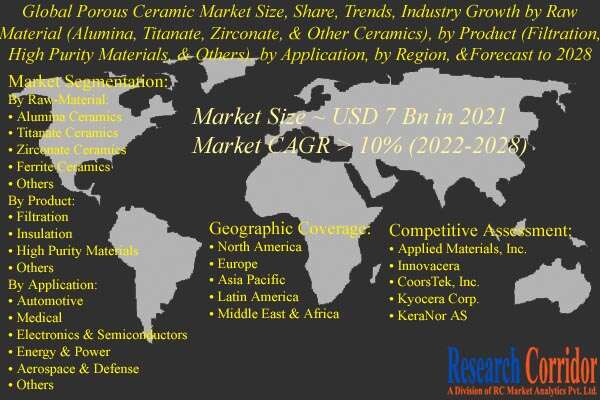
The global porous ceramic market size is expected to experience a significant CAGR of over 10% during the forecast period and was estimated to generate a significant revenue of around USD 7 billion in 2021. The increasing adoption of the product in medical devices and equipment and the rising demand for filtration products are some major factors driving the market growth. Furthermore, the increasing demand for high-quality medical devices, rising safety concerns, and the increasing challenges in healthcare practice are further anticipated to increase the demand for porous ceramic over the forecast period. Moreover, the growing demand for electronics devices and the growth in the automotive industry in developing countries are expected to uplift the market in next upcoming years.
Market Drivers:
Increasing Demand in Filtration Applications: Porous ceramics have excellent filtration properties, making them ideal for various filtration applications such as water treatment, air filtration, and chemical processing. The growing demand for clean water, air quality control, and purification in industries such as pharmaceuticals, chemicals, and electronics drives the need for porous ceramic filters.
Advancements in Material Science and Manufacturing Techniques: Technological advancements in material science and manufacturing techniques have improved the performance and properties of porous ceramics. Innovations in ceramic materials, such as improved pore structure, enhanced surface area, and higher porosity, contribute to their superior filtration, adsorption, and catalytic properties. These advancements drive market growth by expanding the range of applications and improving the overall performance of porous ceramics.
Environmental Regulations and Sustainability: Increasing environmental regulations and a growing focus on sustainability drive the demand for porous ceramics. Porous ceramics can be used as catalyst supports, adsorbents, and filters to remove pollutants and harmful substances from air and water. The ability of porous ceramics to contribute to environmental protection and sustainability initiatives supports their market growth.
Growing Demand in Healthcare and Biomedical Applications: Porous ceramics find extensive use in healthcare and biomedical applications, including bone grafts, dental implants, drug delivery systems, and tissue engineering scaffolds. The biocompatibility, high porosity, and controllable pore structure of porous ceramics make them suitable for these applications. The rising demand for advanced medical treatments, increasing aging population, and the need for personalized healthcare solutions drive the adoption of porous ceramics in the healthcare sector.
Industrial Applications and Chemical Processing: Porous ceramics are used in various industrial applications such as catalyst supports, thermal insulation, refractory materials, and electrodes. Their high-temperature resistance, chemical inertness, and stability make them suitable for harsh industrial environments. The expansion of industries such as petrochemicals, energy, and metallurgy contributes to the demand for porous ceramics in industrial applications.
Automotive and Aerospace Industries: The automotive and aerospace industries utilize porous ceramics for applications such as exhaust gas filters, particulate filters, and thermal management systems. Porous ceramics offer lightweight, high-temperature resistance, and corrosion-resistant properties, making them attractive for use in these industries. The growing automotive and aerospace sectors drive the demand for porous ceramics.
Research and Development Activities: Ongoing research and development activities in the field of porous ceramics drive innovation and expand their applications. Research institutions, academic organizations, and industry players focus on developing new materials, improving manufacturing processes, and exploring novel applications for porous ceramics. These efforts contribute to market growth by pushing the boundaries of what is possible with porous ceramics.
Strategic Collaborations and Partnerships: Collaborations and partnerships between ceramic manufacturers, end-users, and research organizations play a significant role in the growth of the porous ceramic market. These collaborations facilitate knowledge sharing, technology transfer, and the development of customized solutions. Joint efforts enhance the application-specific performance and market penetration of porous ceramics.
Economic Growth and Infrastructure Development: Economic growth, urbanization, and infrastructure development create demand for construction materials and advanced ceramics. Porous ceramics find applications in construction materials such as ceramic tiles, thermal insulators, and acoustic panels. The growth of construction and infrastructure projects worldwide contributes to the demand for porous ceramics.
Regulatory Standards and Quality Control: Compliance with regulatory standards and quality control measures is essential for the adoption of porous ceramics in various industries. Meeting industry-specific standards, such as filtration efficiency, chemical resistance, and mechanical strength, ensures the reliability and performance of porous ceramic products. Adhering to regulatory requirements fosters market acceptance and growth.
Market Snapshot:
| Benchmark Year | 2022 | ||
| Market Size | ~ USD 7 Billion in 2021 | ||
| Market Growth (CAGR) | > 10% (2023-2030) | ||
| Largest Market Share | Asia Pacific | ||
| Analysis Period | 2020-2030 | ||
| Market Players | Applied Materials, Inc., Innovacera, CoorsTek, Inc., Kyocera Corp., and KeraNor AS |
Market Insights:
The global porous ceramic market is bifurcated into raw material, product type, application, and geography. On the basis of product, the market is further segmented into filtration, insulation, and others. The filtration segment dominated the global market in 2021 and is estimated to hold the largest revenue share of over one-third percent by the end of the analysis period. The increasing demand for filtration products in various end-use industries such as automotive, pharmaceuticals, chemicals, and the food industry is a major factor to drive the market growth. On the other hand, the high-purity materials segment is accounted to register the fastest growth rate in the market. The properties associated with the product such as better finishing, excellent hardness, and higher strength are anticipated to fuel the segment growth over the forecast period.
On the basis of application, the market is segmented into automotive, medical, electronics & semiconductors, and others. The automotive segment dominated the global porous ceramic market in 2021 and estimated to hold a significant market share of around one-third market share by 2028. The increasing use of the product in the automotive industry due to its various properties such as excellent mechanical strength, chemical stability, thermal stability, and abrasion resistance is a major factor to drive the segment growth. Furthermore, the increasing investment in the automotive industry by various developing economies and the growing demand for electric vehicles are anticipated to fuel the segment growth.
To know more about the research study, request sample papers
The porous ceramic comprehensive study analyzes industry trends, market size, competitive analysis, and market forecast – 2022 to 2028. Research Corridor report provides detailed premium insight into the global market and reveals the potential revenue streams, commercial prospects, market drivers, challenges, opportunities, issues, and events affecting the industry. In addition, the report has a dedicated section covering market forecasts and analysis for leading geographies, profiles of major companies operating in the market and expert opinion obtained from interviews with industry executives and experts from prominent companies.
The porous ceramic market research report presents the analysis of each segment from 2019 to 2028 considering 2020 as the base year for the research. The compounded annual growth rate (CAGR) for each respective segment is calculated for the forecast period from 2021 to 2027.
Historical & Forecast Period
- 2019-20 – Historical Year
- 2021 – Base Year
- 2022-2028 – Forecast Period
Market Segmentation:
By Raw Material:
- Alumina Ceramics
- Titanate Ceramics
- Zirconate Ceramics
- Ferrite Ceramics
- Aluminum Nitride
- Others
By Product:
- Filtration
- Insulation
- High Purity Materials
- Structural Components
- Others
By Application:
- Automotive
- Medical
- Electronics & Semiconductors
- Energy & Power
- Industrial
- Aerospace & Defense
- Others
By Region:
- North America
- Europe
- Asia Pacific
- Latin America
- Middle East & Africa
Regional Analysis:
Geographically, the Asia Pacific dominated the global porous ceramic market in 2021 and expected to hold the largest market share of over one-third percent of the market by the end of the analysis period. The strong demand for porous ceramic in electronics and semiconductors due to the availability of major manufacturers is a major factor to drive the market growth in the region. Furthermore, the increasing investment in the automotive industry especially in electric vehicles and the growing healthcare sector is further anticipated to fuel the market growth over the forecast period in the Asia Pacific.
Competitive Assessment:
Some of the major market players operating in the global porous ceramic market are Applied Materials, Inc., Innovacera, CoorsTek, Inc., Kyocera Corp., and KeraNor AS. Companies are exploring markets through expansion, new investment, the introduction of new services, and collaboration as their preferred strategies. Players are exploring new geography through expansion and acquisition to gain a competitive advantage through joint synergy.
Key Companies:
- Applied Materials, Inc.
- Innovacera
- CoorsTek, Inc.
- Kyocera Corp.
- KeraNor AS
- NGK Spark Plug Co., Ltd.
- Morgan Advanced Materials
- Porvair plc
- Nishimura Advanced Ceramics Co., Ltd.
- STC Superior Technical Ceramics
Key Questions Answered by Porous Ceramic Market Report
- Global porous ceramic market forecasts from 2022-2028
- Regional market forecasts from 2022-2028 covering Asia-Pacific, North America, Europe, Middle East & Africa, and Latin America
- Country-level forecasts from 2022-2028 covering 15 major countries from the regions as mentioned above
- Porous ceramic submarket forecasts from 2022-2028 covering the market by raw material, by product, by application, and geography
- Various industry models such as SWOT analysis, Value Chain Analysis about the market
- Analysis of the key factors driving and restraining the growth of the global, regional, and country-level porous ceramic markets from 2022-2028
- Competitive Landscape and market positioning of top 10 players operating in the market
1. Preface
1.1. Report Description
1.1.1. Purpose of the Report
1.1.2. Target Audience
1.1.3. USP and Key Offerings
1.2. Research Scope
1.3. Research Methodology
1.3.1. Phase I – Secondary Research
1.3.2. Phase II – Primary Research
1.3.3. Phase III – Expert Panel Review
1.4. Assumptions
2. Executive Summary
2.1. Global Porous Ceramic Market Portraiture
2.2. Global Porous Ceramic Market, by Raw Material, 2021 (USD Mn)
2.3. Global Porous Ceramic Market, by Product, 2021 (USD Mn)
2.4. Global Porous Ceramic Market, by Application, 2021 (USD Mn)
2.5. Global Porous Ceramic Market, by Geography, 2021 (USD Mn)
3. Global Porous Ceramic Market Analysis
3.1. Porous Ceramic Market Overview
3.2. Market Inclination Insights
3.3. Market Dynamics
3.3.1. Drivers
3.3.2. Challenges
3.3.3. Opportunities
3.4. Attractive Investment Proposition
3.5. Competitive Analysis
3.6. Porter’s Five Force Analysis
3.6.1. Bargaining Power of Suppliers
3.6.2. Bargaining Power of Buyers
3.6.3. Threat of New Entrants
3.6.4. Threat of Substitutes
3.6.5. Degree of Competition
3.7. COVID-19 Impact Analysis
4. Global Porous Ceramic Market By Raw Material, 2019 – 2028 (USD Mn)
4.1. Overview
4.2. Alumina Ceramics
4.3. Titanate Ceramics
4.4. Zirconate Ceramics
4.5. Ferrite Ceramics
4.6. Aluminum Nitride
4.7. Others
5. Global Porous Ceramic Market By Product, 2019 – 2028 (USD Mn)
5.1. Overview
5.2. Filtration
5.3. Insulation
5.4. High Purity Materials
5.5. Structural Components
5.6. Others
6. Global Porous Ceramic Market By Application, 2019 – 2028 (USD Mn)
6.1. Overview
6.2. Automotive
6.3. Medical
6.4. Electronics & Semiconductors
6.5. Energy & Power
6.6. Industrial
6.7. Aerospace & Defense
6.8. Others
7. North America Porous Ceramic Market Analysis and Forecast, 2019 – 2028 (USD Mn)
7.1. Overview
7.2. North America Porous Ceramic Market by Raw Material, (2019-2028 USD Mn)
7.3. North America Porous Ceramic Market by Product, (2019-2028 USD Mn)
7.4. North America Porous Ceramic Market by Application, (2019-2028 USD Mn)
7.5. North America Porous Ceramic Market by Country, (2019-2028 USD Mn)
7.5.1. U.S.
7.5.1.1. U.S. Porous Ceramic Market by Raw Material, (2019-2028 USD Mn)
7.5.1.2. U.S. Porous Ceramic Market by Product, (2019-2028 USD Mn)
7.5.1.3. U.S. Porous Ceramic Market by Application, (2019-2028 USD Mn)
7.5.2. Canada
7.5.2.1. Canada Porous Ceramic Market by Raw Material, (2019-2028 USD Mn)
7.5.2.2. Canada Porous Ceramic Market by Product, (2019-2028 USD Mn)
7.5.2.3. Canada Porous Ceramic Market by Application, (2019-2028 USD Mn)
8. Europe Porous Ceramic Market Analysis and Forecast, 2019 – 2028 (USD Mn)
8.1. Overview
8.2. Europe Porous Ceramic Market by Raw Material, (2019-2028 USD Mn)
8.3. Europe Porous Ceramic Market by Product, (2019-2028 USD Mn)
8.4. Europe Porous Ceramic Market by Application, (2019-2028 USD Mn)
8.5. Europe Porous Ceramic Market by Country, (2019-2028 USD Mn)
8.5.1. Germany
8.5.1.1. Germany Porous Ceramic Market by Raw Material, (2019-2028 USD Mn)
8.5.1.2. Germany Porous Ceramic Market by Product, (2019-2028 USD Mn)
8.5.1.3. Germany Porous Ceramic Market by Application, (2019-2028 USD Mn)
8.5.2. U.K.
8.5.2.1. U.K. Porous Ceramic Market by Raw Material, (2019-2028 USD Mn)
8.5.2.2. U.K. Porous Ceramic Market by Product, (2019-2028 USD Mn)
8.5.2.3. U.K. Porous Ceramic Market by Application, (2019-2028 USD Mn)
8.5.3. France
8.5.3.1. France Porous Ceramic Market by Raw Material, (2019-2028 USD Mn)
8.5.3.2. France Porous Ceramic Market by Product, (2019-2028 USD Mn)
8.5.3.3. France Porous Ceramic Market by Application, (2019-2028 USD Mn)
8.5.4. Italy
8.5.4.1. Italy Porous Ceramic Market by Raw Material, (2019-2028 USD Mn)
8.5.4.2. Italy Porous Ceramic Market by Product, (2019-2028 USD Mn)
8.5.4.3. Italy Porous Ceramic Market by Application, (2019-2028 USD Mn)
8.5.5. Rest of Europe
8.5.5.1. Rest of Europe Porous Ceramic Market by Raw Material, (2019-2028 USD Mn)
8.5.5.2. Rest of Europe Porous Ceramic Market by Product, (2019-2028 USD Mn)
8.5.5.3. Rest of Europe Porous Ceramic Market by Application, (2019-2028 USD Mn)
9. Asia Pacific Porous Ceramic Market Analysis and Forecast, 2019 – 2028 (USD Mn)
9.1. Overview
9.2. Asia Pacific Porous Ceramic Market by Raw Material, (2019-2028 USD Mn)
9.3. Asia Pacific Porous Ceramic Market by Product, (2019-2028 USD Mn)
9.4. Asia Pacific Porous Ceramic Market by Application, (2019-2028 USD Mn)
9.5. Asia Pacific Porous Ceramic Market by Country, (2019-2028 USD Mn)
9.5.1. China
9.5.1.1. China Porous Ceramic Market by Raw Material, (2019-2028 USD Mn)
9.5.1.2. China Porous Ceramic Market by Product, (2019-2028 USD Mn)
9.5.1.3. China Porous Ceramic Market by Application, (2019-2028 USD Mn)
9.5.2. Japan
9.5.2.1. Japan Porous Ceramic Market by Raw Material, (2019-2028 USD Mn)
9.5.2.2. Japan Porous Ceramic Market by Product, (2019-2028 USD Mn)
9.5.2.3. Japan Porous Ceramic Market by Application, (2019-2028 USD Mn)
9.5.3. India
9.5.3.1. India Porous Ceramic Market by Raw Material, (2019-2028 USD Mn)
9.5.3.2. India Porous Ceramic Market by Product, (2019-2028 USD Mn)
9.5.3.3. India Porous Ceramic Market by Application, (2019-2028 USD Mn)
9.5.4. Rest of Asia Pacific
9.5.4.1. Rest of Asia Pacific Porous Ceramic Market by Raw Material, (2019-2028 USD Mn)
9.5.4.2. Rest of Asia Pacific Porous Ceramic Market by Product, (2019-2028 USD Mn)
9.5.4.3. Rest of Asia Pacific Porous Ceramic Market by Application, (2019-2028 USD Mn)
10. Latin America (LATAM) Porous Ceramic Market Analysis and Forecast, 2019 – 2028 (USD Mn)
10.1. Overview
10.2. Latin America Porous Ceramic Market by Raw Material, (2019-2028 USD Mn)
10.3. Latin America Porous Ceramic Market by Product, (2019-2028 USD Mn)
10.4. Latin America Porous Ceramic Market by Application, (2019-2028 USD Mn)
10.5. Latin America Porous Ceramic Market by Country, (2019-2028 USD Mn)
10.5.1. Brazil
10.5.1.1. Brazil Porous Ceramic Market by Raw Material, (2019-2028 USD Mn)
10.5.1.2. Brazil Porous Ceramic Market by Product, (2019-2028 USD Mn)
10.5.1.3. Brazil Porous Ceramic Market by Application, (2019-2028 USD Mn)
10.5.2. Mexico
10.5.2.1. Mexico Porous Ceramic Market by Raw Material, (2019-2028 USD Mn)
10.5.2.2. Mexico Porous Ceramic Market by Product, (2019-2028 USD Mn)
10.5.2.3. Mexico Porous Ceramic Market by Application, (2019-2028 USD Mn)
10.5.3. Rest of Latin America
10.5.3.1. Rest of Latin America Porous Ceramic Market by Raw Material, (2019-2028 USD Mn)
10.5.3.2. Rest of Latin America Porous Ceramic Market by Product, (2019-2028 USD Mn)
10.5.3.3. Rest of Latin America Porous Ceramic Market by Application, (2019-2028 USD Mn)
11. Middle East and Africa Porous Ceramic Market Analysis and Forecast, 2019 – 2028 (USD Mn)
11.1. Overview
11.2. MEA Porous Ceramic Market by Raw Material, (2019-2028 USD Mn)
11.3. MEA Porous Ceramic Market by Product, (2019-2028 USD Mn)
11.4. MEA Porous Ceramic Market by Application, (2019-2028 USD Mn)
11.5. Middle East and Africa Porous Ceramic Market, by Country, (2019-2028 USD Mn)
11.5.1. GCC
11.5.1.1. GCC Porous Ceramic Market by Raw Material, (2019-2028 USD Mn)
11.5.1.2. GCC Porous Ceramic Market by Product, (2019-2028 USD Mn)
11.5.1.3. GCC Porous Ceramic Market by Application, (2019-2028 USD Mn)
11.5.2. South Africa
11.5.2.1. South Africa Porous Ceramic Market by Raw Material, (2019-2028 USD Mn)
11.5.2.2. South Africa Porous Ceramic Market by Product, (2019-2028 USD Mn)
11.5.2.3. South Africa Porous Ceramic Market by Application, (2019-2028 USD Mn)
11.5.3. Rest of MEA
11.5.3.1. Rest of MEA Porous Ceramic Market by Raw Material, (2019-2028 USD Mn)
11.5.3.2. Rest of MEA Porous Ceramic Market by Product, (2019-2028 USD Mn)
11.5.3.3. Rest of MEA Porous Ceramic Market by Application, (2019-2028 USD Mn)
12. Company Profiles
12.1. Applied Materials, Inc.
12.1.1. Business Description
12.1.2. Financial Health and Budget Allocation
12.1.3. Product Positions/Portfolio
12.1.4. Recent Development
12.1.5. SWOT Analysis
12.2. Innovacera
12.2.1. Business Description
12.2.2. Financial Health and Budget Allocation
12.2.3. Product Positions/Portfolio
12.2.4. Recent Development
12.2.5. SWOT Analysis
12.3. CoorsTek, Inc.
12.3.1. Business Description
12.3.2. Financial Health and Budget Allocation
12.3.3. Product Positions/Portfolio
12.3.4. Recent Development
12.3.5. SWOT Analysis
12.4. Kyocera Corp.
12.4.1. Business Description
12.4.2. Financial Health and Budget Allocation
12.4.3. Product Positions/Portfolio
12.4.4. Recent Development
12.4.5. SWOT Analysis
12.5. KeraNor AS
12.5.1. Business Description
12.5.2. Financial Health and Budget Allocation
12.5.3. Product Positions/Portfolio
12.5.4. Recent Development
12.5.5. SWOT Analysis
12.6. NGK Spark Plug Co., Ltd.
12.6.1. Business Description
12.6.2. Financial Health and Budget Allocation
12.6.3. Product Positions/Portfolio
12.6.4. Recent Development
12.6.5. SWOT Analysis
12.7. Morgan Advanced Materials
12.7.1. Business Description
12.7.2. Financial Health and Budget Allocation
12.7.3. Product Positions/Portfolio
12.7.4. Recent Development
12.7.5. SWOT Analysis
12.8. Porvair plc
12.8.1. Business Description
12.8.2. Financial Health and Budget Allocation
12.8.3. Product Positions/Portfolio
12.8.4. Recent Development
12.8.5. SWOT Analysis
12.9. Nishimura Advanced Ceramics Co., Ltd.
12.9.1. Business Description
12.9.2. Financial Health and Budget Allocation
12.9.3. Product Positions/Portfolio
12.9.4. Recent Development
12.9.5. SWOT Analysis
12.10. STC Superior Technical Ceramics
12.10.1. Business Description
12.10.2. Financial Health and Budget Allocation
12.10.3. Product Positions/Portfolio
12.10.4. Recent Development
12.10.5. SWOT Analysis
$ 5200/- Multi User License

We understand that every business has unique requirements. This report can be customized based on:
- Deep regional & country-level market intelligence
- Application-specific and end-use industry segmentation
- Competitive landscape & strategic benchmarking
- Go-to-market and expansion strategy insights
- Custom data cuts aligned to your business goals
- Structured Primary Research Framework
- On-Demand Industry Expert Interviews Available
- Dedicated Analyst Support
- Custom Data On Request
- Post-Purchase Strategy Consultation
- Complimentary 30-min Analyst Session
- 30% of Our Clients Are Returning Enterprise Buyers
Our Clients