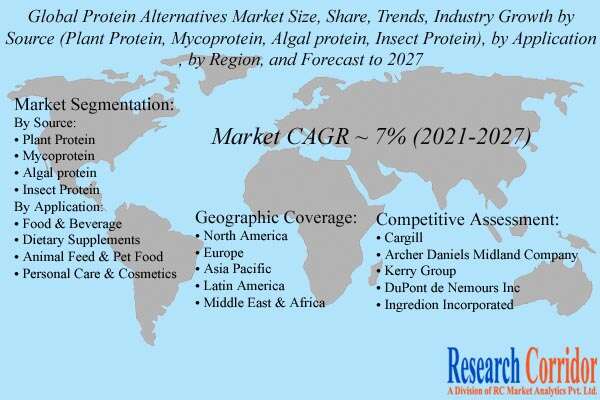
The global protein alternatives market size is expected to witness a lucrative CAGR of around 7% during the forecast period 2021 to 2027. The increasing consumer preference towards plant-based protein over animal protein is a major factor to drive the market growth. Furthermore, the increasing sports activity across the globe is further anticipated to fuel the market growth over the forecast period. moreover, the rising health awareness among consumers is anticipated to increase the demand for protein products as consumers have started to add more protein to their daily diet, which is expected to propel the market growth.
Market Drivers:
Growing Demand for Plant-Based and Sustainable Protein Sources: There is an increasing global demand for plant-based protein alternatives driven by various factors such as health consciousness, environmental concerns, and ethical considerations. Plant-based proteins, including those derived from soy, pea, wheat, and other sources, are perceived as more sustainable and environmentally friendly compared to animal-based proteins, leading to their rising popularity.
Rising Health and Wellness Consciousness: Consumers are becoming more health-conscious and seeking protein alternatives that offer nutritional benefits and align with their dietary preferences. Plant-based protein alternatives are often perceived as healthier options due to their lower levels of saturated fats, cholesterol, and allergenic potential compared to animal-based proteins. The growing awareness of the health benefits associated with plant-based proteins drives their demand.
Increasing Incidence of Food Allergies and Intolerances: Food allergies and intolerances, including lactose intolerance and dairy allergies, have prompted many consumers to seek protein alternatives that are free from allergens commonly found in animal-based proteins. Plant-based protein alternatives offer allergen-free options, making them suitable for individuals with dietary restrictions or allergies.
Environmental Concerns and Sustainable Food Production: The environmental impact of animal agriculture, including greenhouse gas emissions, deforestation, water consumption, and land use, has led to increased awareness about the sustainability of food production. Plant-based protein alternatives require fewer resources and have a lower environmental footprint compared to animal-based proteins, driving their demand among environmentally conscious consumers.
Ethical and Animal Welfare Considerations: Concerns regarding animal welfare and the ethical treatment of animals have led many consumers to seek protein alternatives that do not involve animal exploitation. Plant-based proteins provide a cruelty-free option, appealing to consumers who prioritize ethical considerations in their food choices.
Technological Advancements in Protein Alternatives: Continuous advancements in food technology and processing techniques have led to the development of innovative protein alternatives that closely mimic the taste, texture, and nutritional profile of animal-based proteins. Improved taste, texture, and variety in plant-based protein alternatives contribute to their growing acceptance among consumers.
Availability and Expansion of Product Offerings: The availability and variety of protein alternatives have increased significantly in recent years. Manufacturers are introducing a wide range of plant-based protein products, including plant-based meats, dairy alternatives, protein powders, and protein-rich snacks. The expansion of product offerings makes it easier for consumers to incorporate protein alternatives into their diets, driving market growth.
Marketing and Influencer Influence: The marketing efforts and influence of celebrities, social media influencers, and health experts play a significant role in driving the adoption of protein alternatives. Increased media coverage, endorsements, and the promotion of plant-based lifestyles by influential individuals contribute to the awareness and popularity of protein alternatives among consumers.
Government Initiatives and Policies: Government initiatives aimed at promoting healthy eating habits, sustainable food systems, and reducing the consumption of animal-based proteins can drive the demand for protein alternatives. Some governments provide incentives, grants, or subsidies to support the production and consumption of plant-based proteins, contributing to market growth.
Market Snapshot:
| Benchmark Year | 2022 | ||
| Market Size | lock | ||
| Market Growth (CAGR) | ~ 7% (2023-2030) | ||
| Largest Market Share | North America | ||
| Analysis Period | 2020-2030 | ||
| Market Players | Cargill, Archer Daniels Midland Company, Kerry Group, DuPont de Nemours Inc., and Ingredion Incorporated |
Market Insights:
The global protein alternatives market is bifurcated into the source, application, and geography. On the basis of source, the market is further segmented into plant protein, mycoprotein, algal protein, and insect protein. The plant protein segment dominated the global market in 2020 and expected to hold the largest revenue share of over one-third percent of the market by the end of the analysis period. The increasing consumer shift towards plant-based products due to their health benefits is a major factor to drive the segment growth. Furthermore, the increasing demand for vegan dietary habits is further anticipated to boost the segment growth over the forecast period.
To know more about the study, request sample papers
The protein alternatives comprehensive study analyzes industry trends, market size, competitive analysis, and market forecast – 2021 to 2027. Research Corridor report provides detailed premium insight into the global market and reveals the potential revenue streams, commercial prospects, market drivers, challenges, opportunities, issues, and events affecting the industry. In addition, the report has a dedicated section covering market forecasts and analysis for leading geographies, profiles of major companies operating in the market and expert opinion obtained from interviews with industry executives and experts from prominent companies.
The protein alternatives market research report presents the analysis of each segment from 2018 to 2027 considering 2020 as the base year for the research. The compounded annual growth rate (CAGR) for each respective segment is calculated for the forecast period from 2021 to 2027.
Historical & Forecast Period
- 2018-19 – Historical Year
- 2020 – Base Year
- 2021-2027 – Forecast Period
Market Segmentation:
By Source:
- Plant Protein
- Mycoprotein
- Algal protein
- Insect Protein
By Application:
- Food and Beverage
- Dietary Supplements
- Animal Feed and Pet Food
- Personal Care and Cosmetics
By Region:
- North America
- Europe
- Asia Pacific
- Latin America
- Middle East & Africa
Geographic Coverage
Geographically, North America dominated the global protein alternatives market in 2020 and accounted to hold the largest revenue share of over one-third of the market by the end of the analysis period. The rising awareness regarding health and wellness, and growing preference towards protein-based diets are some of the major factors to drive the market growth in the region. Furthermore, the increasing adoption of functional food and dietary supplements is further expected to fuel market growth in North America. Moreover, the increasing inclination towards vegan-based protein products and the growing awareness about the health benefits associated with it is expected to boost the market growth.
Competitive Assessment
Some of the major market players operating in the global protein alternatives market are Cargill, Archer Daniels Midland Company, Kerry Group, DuPont de Nemours Inc., and Ingredion Incorporated. Companies are exploring markets through expansion, new investment, the introduction of new services, and collaboration as their preferred strategies. Players are exploring new geography through expansion and acquisition to gain a competitive advantage through joint synergy.
Key Companies:
- Cargill
- Archer Daniels Midland Company
- Kerry Group
- DuPont de Nemours Inc
- Ingredion Incorporated
- Corbion NV
- Glanbia PLC
- Royal Avebe UA
- Koninklijke DSM N.V.
- Agriprotein Holdings Ltd.
Key Questions Answered by Protein Alternatives Market Report
- Global protein alternatives market forecasts from 2021-2027
- Regional protein alternatives market forecasts from 2021-2027 covering Asia-Pacific, North America, Europe, Middle East & Africa, and Latin America
- Country-level forecasts from 2021-2027 covering 15 major countries from the regions as mentioned above
- Protein alternatives submarket forecasts from 2021-2027 cover the market by source, by application, and geography
- Various industry models such as SWOT analysis, Value Chain Analysis about protein alternatives market
- Analysis of the key factors driving and restraining the growth of the global, regional, and country-level protein alternatives markets from 2021-2027
- Competitive Landscape and market positioning of top 10 players operating in the protein alternatives market
1. Preface
1.1. Report Description
1.1.1. Purpose of the Report
1.1.2. Target Audience
1.1.3. USP and Key Offerings
1.2. Research Scope
1.3. Research Methodology
1.3.1. Phase I – Secondary Research
1.3.2. Phase II – Primary Research
1.3.3. Phase III – Expert Panel Review
1.4. Assumptions
2. Executive Summary
2.1. Global Protein Alternatives Market Portraiture
2.2. Global Protein Alternatives Market, by Source, 2020 (USD Mn)
2.3. Global Protein Alternatives Market, by Application, 2020 (USD Mn)
2.4. Global Protein Alternatives Market, by Geography, 2020 (USD Mn)
3. Global Protein Alternatives Market Analysis
3.1. Protein Alternatives Market Overview
3.2. Market Inclination Insights
3.3. Market Dynamics
3.3.1. Drivers
3.3.2. Challenges
3.3.3. Opportunities
3.4. Attractive Investment Proposition
3.5. Competitive Analysis
3.6. Porter’s Five Force Analysis
3.6.1. Bargaining Power of Suppliers
3.6.2. Bargaining Power of Buyers
3.6.3. Threat of New Entrants
3.6.4. Threat of Substitutes
3.6.5. Degree of Competition
3.7. COVID-19 Impact Analysis
4. Global Protein Alternatives Market By Source, 2018 – 2027 (USD Mn)
4.1. Overview
4.2. Plant Protein
4.3. Mycoprotein
4.4. Algal protein
4.5. Insect Protein
5. Global Protein Alternatives Market By Application, 2018 – 2027 (USD Mn)
5.1. Overview
5.2. Food and Beverage
5.3. Dietary Supplements
5.4. Animal Feed and Pet Food
5.5. Personal Care and Cosmetics
6. North America Protein Alternatives Market Analysis and Forecast, 2018 – 2027 (USD Mn)
6.1.1. Overview
6.1.2. North America Protein Alternatives Market by Source (2018-2027 USD Mn)
6.1.3. North America Protein Alternatives Market by Application (2018-2027 USD Mn)
6.1.4. North America Protein Alternatives Market by Country (2018-2027 USD Mn)
6.1.4.1. U.S.
6.1.4.1.1. U.S. Protein Alternatives Market by Source (2018-2027 USD Mn)
6.1.4.1.2. U.S. Protein Alternatives Market by Application (2018-2027 USD Mn)
6.1.4.2. Canada
6.1.4.2.1. Canada Protein Alternatives Market by Source (2018-2027 USD Mn)
6.1.4.2.2. Canada Protein Alternatives Market by Application (2018-2027 USD Mn)
7. Europe Protein Alternatives Market Analysis and Forecast, 2018 – 2027 (USD Mn)
7.1.1. Overview
7.1.2. Europe Protein Alternatives Market by Source (2018-2027 USD Mn)
7.1.3. Europe Protein Alternatives Market by Application (2018-2027 USD Mn)
7.1.4. Europe Protein Alternatives Market by Country (2018-2027 USD Mn)
7.1.4.1. Germany
7.1.4.1.1. Germany Protein Alternatives Market by Source (2018-2027 USD Mn)
7.1.4.1.2. Germany Protein Alternatives Market by Application (2018-2027 USD Mn)
7.1.4.2. U.K.
7.1.4.2.1. U.K. Protein Alternatives Market by Source (2018-2027 USD Mn)
7.1.4.2.2. U.K. Protein Alternatives Market by Application (2018-2027 USD Mn)
7.1.4.3. France
7.1.4.3.1. France Protein Alternatives Market by Source (2018-2027 USD Mn)
7.1.4.3.2. France Protein Alternatives Market by Application (2018-2027 USD Mn)
7.1.4.4. Italy
7.1.4.4.1. Italy Protein Alternatives Market by Source (2018-2027 USD Mn)
7.1.4.4.2. Italy Protein Alternatives Market by Application (2018-2027 USD Mn)
7.1.4.5. Rest of Europe
7.1.4.5.1. Rest of Europe Protein Alternatives Market by Source (2018-2027 USD Mn)
7.1.4.5.2. Rest of Europe Protein Alternatives Market by Application (2018-2027 USD Mn)
8. Asia Pacific Protein Alternatives Market Analysis and Forecast, 2018 – 2027 (USD Mn)
8.1.1. Overview
8.1.2. Asia Pacific Protein Alternatives Market by Source (2018-2027 USD Mn)
8.1.3. Asia Pacific Protein Alternatives Market by Application (2018-2027 USD Mn)
8.1.4. Asia Pacific Protein Alternatives Market by Country (2018-2027 USD Mn)
8.1.4.1. China
8.1.4.1.1. China Protein Alternatives Market by Source (2018-2027 USD Mn)
8.1.4.1.2. China Protein Alternatives Market by Application (2018-2027 USD Mn)
8.1.4.2. Japan
8.1.4.2.1. Japan Protein Alternatives Market by Source (2018-2027 USD Mn)
8.1.4.2.2. Japan Protein Alternatives Market by Application (2018-2027 USD Mn)
8.1.4.3. Rest of Asia Pacific
8.1.4.3.1. Rest of Asia Pacific Protein Alternatives Market by Source (2018-2027 USD Mn)
8.1.4.3.2. Rest of Asia Pacific Protein Alternatives Market by Application (2018-2027 USD Mn)
9. Latin America (LATAM) Protein Alternatives Market Analysis and Forecast, 2018 – 2027 (USD Mn)
9.1.1. Overview
9.1.2. Latin America Protein Alternatives Market by Source (2018-2027 USD Mn)
9.1.3. Latin America Protein Alternatives Market by Application (2018-2027 USD Mn)
9.1.4. Latin America Protein Alternatives Market by Country (2018-2027 USD Mn)
9.1.4.1. Brazil
9.1.4.1.1. Brazil Protein Alternatives Market by Source (2018-2027 USD Mn)
9.1.4.1.2. Brazil Protein Alternatives Market by Application (2018-2027 USD Mn)
9.1.4.2. Mexico
9.1.4.2.1. Mexico Protein Alternatives Market by Source (2018-2027 USD Mn)
9.1.4.2.2. Mexico Protein Alternatives Market by Application (2018-2027 USD Mn)
9.1.4.3. Rest of Latin America
9.1.4.3.1. Rest of Latin America Protein Alternatives Market by Source (2018-2027 USD Mn)
9.1.4.3.2. Rest of Latin America Protein Alternatives Market by Application (2018-2027 USD Mn)
10. Middle East and Africa Protein Alternatives Market Analysis and Forecast, 2018 – 2027 (USD Mn)
10.1.1. Overview
10.1.2. MEA Protein Alternatives Market by Source (2018-2027 USD Mn)
10.1.3. MEA Protein Alternatives Market by Application (2018-2027 USD Mn)
10.1.4. Middle East and Africa Protein Alternatives Market, by Country (2018-2027 USD Mn)
10.1.4.1. GCC
10.1.4.1.1. GCC Protein Alternatives Market by Source (2018-2027 USD Mn)
10.1.4.1.2. GCC Protein Alternatives Market by Application (2018-2027 USD Mn)
10.1.4.2. South Africa
10.1.4.2.1. South Africa Protein Alternatives Market by Source (2018-2027 USD Mn)
10.1.4.2.2. South Africa Protein Alternatives Market by Application (2018-2027 USD Mn)
10.1.4.3. Rest of MEA
10.1.4.3.1. Rest of MEA Protein Alternatives Market by Source (2018-2027 USD Mn)
10.1.4.3.2. Rest of MEA Protein Alternatives Market by Application (2018-2027 USD Mn)
11. Company Profiles
11.1. Cargill
11.1.1. Business Description
11.1.2. Financial Health and Budget Allocation
11.1.3. Product Positions/Portfolio
11.1.4. Recent Development
11.1.5. SWOT Analysis
11.2. Archer Daniels Midland Company
11.2.1. Business Description
11.2.2. Financial Health and Budget Allocation
11.2.3. Product Positions/Portfolio
11.2.4. Recent Development
11.2.5. SWOT Analysis
11.3. Kerry Group
11.3.1. Business Description
11.3.2. Financial Health and Budget Allocation
11.3.3. Product Positions/Portfolio
11.3.4. Recent Development
11.3.5. SWOT Analysis
11.4. DuPont de Nemours Inc.
11.4.1. Business Description
11.4.2. Financial Health and Budget Allocation
11.4.3. Product Positions/Portfolio
11.4.4. Recent Development
11.4.5. SWOT Analysis
11.5. Ingredion Incorporated
11.5.1. Business Description
11.5.2. Financial Health and Budget Allocation
11.5.3. Product Positions/Portfolio
11.5.4. Recent Development
11.5.5. SWOT Analysis
11.6. Corbion NV
11.6.1. Business Description
11.6.2. Financial Health and Budget Allocation
11.6.3. Product Positions/Portfolio
11.6.4. Recent Development
11.6.5. SWOT Analysis
11.7. Glanbia PLC
11.7.1. Business Description
11.7.2. Financial Health and Budget Allocation
11.7.3. Product Positions/Portfolio
11.7.4. Recent Development
11.7.5. SWOT Analysis
11.8. Royal Avebe UA
11.8.1. Business Description
11.8.2. Financial Health and Budget Allocation
11.8.3. Product Positions/Portfolio
11.8.4. Recent Development
11.8.5. SWOT Analysis
11.9. Koninklijke DSM N.V.
11.9.1. Business Description
11.9.2. Financial Health and Budget Allocation
11.9.3. Product Positions/Portfolio
11.9.4. Recent Development
11.9.5. SWOT Analysis
11.10. Agriprotein Holdings Ltd.
11.10.1. Business Description
11.10.2. Financial Health and Budget Allocation
11.10.3. Product Positions/Portfolio
11.10.4. Recent Development
11.10.5. SWOT Analysis
$ 5200/- Multi User License

We understand that every business has unique requirements. This report can be customized based on:
- Deep regional & country-level market intelligence
- Application-specific and end-use industry segmentation
- Competitive landscape & strategic benchmarking
- Go-to-market and expansion strategy insights
- Custom data cuts aligned to your business goals
- Structured Primary Research Framework
- On-Demand Industry Expert Interviews Available
- Dedicated Analyst Support
- Custom Data On Request
- Post-Purchase Strategy Consultation
- Complimentary 30-min Analyst Session
- 30% of Our Clients Are Returning Enterprise Buyers
Our Clients