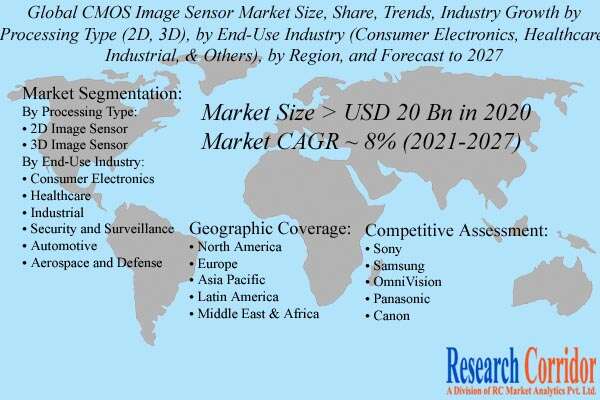
The global CMOS image sensor market size is expected to witness a significant CAGR of around 8% during the forecast period and was estimated at over USD 20 billion in 2020. The increasing adoption of the product in various industries due to the growing demand for high definition image capturing devices is one of the major factor to drive the market growth. Furthermore, the growing trend of multiple cameras in smartphones is further anticipated to boost the market over the forecast period. Moreover, the increasing adoption of the technology in the defense and automotive sector is anticipated to boost the market growth.
For the past decade, smartphones have completely disrupted the imaging market and its associated technology. Smartphones will become the primary imaging device for consumers in the near future. Social media is growing continuously which is fueling the demand for high-quality images which is expected to increase the demand for better quality imaging smartphone cameras that exponentially drives the CMOS image sensors.
Market Drivers:
Increasing Demand for Smartphones and Consumer Electronics: The widespread adoption of smartphones, tablets, digital cameras, and other consumer electronics devices is a significant driver for the CMOS image sensor market. CMOS image sensors are used in these devices to capture high-quality images and videos. The growing demand for advanced camera functionalities, such as high-resolution imaging, low-light performance, and fast autofocus, drives the need for CMOS image sensors.
Advancements in Automotive Safety and Driver Assistance Systems: The automotive industry is increasingly integrating advanced driver assistance systems (ADAS) and safety features in vehicles. CMOS image sensors play a crucial role in ADAS applications, such as lane departure warning, adaptive cruise control, and collision avoidance. The demand for CMOS image sensors in automotive applications is driven by the need for improved safety, enhanced situational awareness, and autonomous driving technologies.
Growing Adoption of Machine Vision and Industrial Automation: The adoption of machine vision systems and industrial automation in manufacturing and industrial sectors is a significant driver for the CMOS image sensor market. CMOS image sensors are used in machine vision systems for inspection, quality control, and process monitoring applications. The ability of CMOS image sensors to capture high-resolution images at high frame rates, along with their cost-effectiveness and compact size, make them ideal for industrial automation applications.
Expansion of the Healthcare and Life Sciences Industry: The healthcare and life sciences industry relies on CMOS image sensors for various applications, including medical imaging, diagnostics, and microscopy. CMOS image sensors offer advantages such as high resolution, low power consumption, and integration with other devices, enabling advanced imaging techniques and improved patient care. The increasing demand for medical devices and advancements in healthcare technologies contribute to the growth of the CMOS image sensor market in the healthcare sector.
Advancements in Image Sensor Technology: Continuous advancements in CMOS image sensor technology drive the market growth. These advancements include improvements in pixel size, sensitivity, noise reduction, dynamic range, and low-light performance. The development of backside-illuminated (BSI) CMOS image sensors, stacked image sensor architectures, and advanced fabrication techniques contribute to enhanced performance and capabilities of CMOS image sensors, expanding their applications across various industries.
Cost-Effectiveness and Scalability: CMOS image sensors offer cost advantages compared to other image sensor technologies, such as CCD (Charge-Coupled Device) sensors. CMOS sensors are manufactured using standard CMOS process technology, which allows for high-volume production and cost-effective manufacturing. The scalability of CMOS image sensor production enables their integration into a wide range of devices and applications.
Miniaturization and Integration Requirements: The trend toward miniaturization and integration of components in electronic devices drives the demand for compact and highly integrated CMOS image sensors. CMOS sensors can be designed with small form factors and integrated with other functionalities, such as image processing, autofocus, and image stabilization. The ability to incorporate CMOS image sensors into small and portable devices contributes to their growing adoption.
Increasing Popularity of IoT and Wearable Devices: The growing popularity of IoT (Internet of Things) and wearable devices is a driving factor for the CMOS image sensor market. CMOS image sensors are used in wearable devices, such as smartwatches, fitness trackers, and augmented reality (AR) glasses, to capture images and enable visual-based functionalities. The demand for CMOS image sensors in IoT and wearable devices is driven by the need for compact size, low power consumption, and high-performance imaging capabilities.
Market Snapshot:
| Benchmark Year | 2022 | ||
| Market Size | > USD 20 Billion in 2020 | ||
| Market Growth (CAGR) | ~ 8% (2023-2030) | ||
| Largest Market Share | Asia Pacific | ||
| Analysis Period | 2020-2030 | ||
| Market Players | Sony, Samsung, OmniVision, Panasonic, and Canon |
Market Insights:
The consumer electronics segment dominated the global CMOS image sensor market
The global CMOS image sensor market is bifurcated into Processing Type, end-use industry, and geography. On the basis of the end-use industry, the market is further segmented into Consumer Electronics, Healthcare, Industrial, automotive, and others. The consumer electronics segment dominated the global market in 2020 and is expected to maintain its dominance over the forecast period. The increasing focus of manufacturers to provide the best quality camera in smartphones is a major factor to drive the segment growth. Furthermore, the increasing penetration of smartphones, tablets, and DSLR cameras is further expected to fuel the segment growth over the forecast period.
By processing type, the 3D image sensor segment is expected to drive the CMOS image sensor market at the highest growth rate
On the basis of processing type, the global CMOS image sensor market is segmented into 2D and 3D image sensors. The 3D image sensor segment is expected to register the fastest growth rate over the forecast period. Emerging technologies such as computer vision and machine vision are some of the major factors to drive the segment growth. Furthermore, the increasing adoption of the technology in various applications such as 3D scanning, 3D biometric identification, and hand gesture is further expected to fuel the segment growth over the forecast period. In addition, the growing AR applications and 3D computational photography is expected to provide new opportunities in the market.
To know more about the study, request a report sample
The CMOS image sensor comprehensive study analyzes industry trends, market size, competitive analysis, and market forecast – 2022 to 2028. Research Corridor report provides detailed premium insight into the global market and reveals the potential revenue streams, commercial prospects, market drivers, challenges, opportunities, issues, and events affecting the industry. In addition, the report has a dedicated section covering market forecasts and analysis for leading geographies, profiles of major companies operating in the market and expert opinion obtained from interviews with industry executives and experts from prominent companies.
The CMOS image sensor market research report presents the analysis of each segment from 2019 to 2028 considering 2020 as the base year for the research. The compounded annual growth rate (CAGR) for each respective segment is calculated for the forecast period from 2021 to 2027.
Historical & Forecast Period
- 2019-20 – Historical Year
- 2021 – Base Year
- 2022-2028 – Forecast Period
Market Segmentation:
By Processing Type:
- 2D Image Sensor
- 3D Image Sensor
By End-Use Industry:
- Consumer Electronics
- Healthcare
- Industrial
- Security and Surveillance
- Automotive
- Aerospace and Defense
By Region:
- North America
- Europe
- Asia Pacific
- Latin America
- Middle East & Africa
Geographic Coverage:
The Asia Pacific is expected to hold the largest share of the global CMOS image sensor market by 2027
Geographically, the Asia Pacific dominated the global CMOS image sensor market in 2020 and is expected to hold the largest revenue share of around half of the market by the end of the analysis period. The rapid growth in the semiconductor industry and the presence of some major players are some major factors to drive the market growth in the region. China is the largest producer and consumer of semiconductors and accounts to hold a significant share of over one-third market share of the semiconductor industry. Furthermore, the increasing adoption of smart cities and the growing surveillance and monitoring activities are further expected to fuel the market growth in the region.
Competitive Assessment:
Some of the leading market players operating in the global CMOS image sensor market are Sony, Samsung, OmniVision, Panasonic, and Canon. The top three leading players are estimated to hold the largest market share around 75% of the global market in 2020. Companies are exploring markets through expansion, new investment, the introduction of new services, and collaboration as their preferred strategies. Players are exploring new geography through expansion and acquisition to gain a competitive advantage through joint synergy.
Key Companies:
- Sony
- Samsung
- OmniVision
- Panasonic
- Canon
- GalaxyCore
- On Semiconductor
- STMicroelectronics
- SK Hynix
- Smartsens
Key Questions Answered by CMOS Image Sensor Market Report
- Global CMOS image sensor market forecasts from 2022-2028
- Regional market forecasts from 2022-2028 covering Asia-Pacific, North America, Europe, Middle East & Africa, and Latin America
- Country-level forecasts from 2022-2028 covering 15 major countries from the regions as mentioned above
- CMOS image sensor submarket forecasts from 2022-2028 covering the market by processing type, by end-use industry, and geography
- Various industry models such as SWOT analysis, Value Chain Analysis about the market
- Analysis of the key factors driving and restraining the growth of the global, regional, and country-level CMOS image sensor markets from 2022-2028
- Competitive Landscape and market positioning of top 10 players operating in the market
1. Preface
1.1. Report Description
1.1.1. Purpose of the Report
1.1.2. Target Audience
1.1.3. USP and Key Offerings
1.2. Research Scope
1.3. Research Methodology
1.3.1. Phase I – Secondary Research
1.3.2. Phase II – Primary Research
1.3.3. Phase III – Expert Panel Review
1.4. Assumptions
2. Executive Summary
2.1. Global CMOS Image Sensor Market Portraiture
2.2. Global CMOS Image Sensor Market, by Processing Type, 2021 (USD Mn)
2.3. Global CMOS Image Sensor Market, by End-Use Industry, 2021 (USD Mn)
2.4. Global CMOS Image Sensor Market, by Geography, 2021 (USD Mn)
3. Global CMOS Image Sensor Market Analysis
3.1. CMOS Image Sensor Market Overview
3.2. Market Inclination Insights
3.3. Market Dynamics
3.3.1. Drivers
3.3.2. Challenges
3.3.3. Opportunities
3.4. Attractive Investment Proposition
3.5. Competitive Analysis
3.6. Porter’s Five Force Analysis
3.6.1. Bargaining Power of Suppliers
3.6.2. Bargaining Power of Buyers
3.6.3. Threat of New Entrants
3.6.4. Threat of Substitutes
3.6.5. Degree of Competition
3.7. COVID-19 Impact Analysis
4. Global CMOS Image Sensor Market By Processing Type, 2019 – 2028 (USD Mn)
4.1. Overview
4.2. 2D Image Sensor
4.3. 3D Image Sensor
5. Global CMOS Image Sensor Market By End-Use Industry, 2019 – 2028 (USD Mn)
5.1. Overview
5.2. Consumer Electronics
5.3. Healthcare
5.4. Industrial
5.5. Security and Surveillance
5.6. Automotive
5.7. Aerospace and Defense
6. North America CMOS Image Sensor Market Analysis and Forecast, 2019 – 2028 (USD Mn)
6.1.1. Overview
6.1.2. North America CMOS Image Sensor Market by Processing Type (2019-2028 USD Mn)
6.1.3. North America CMOS Image Sensor Market by End-Use Industry (2019-2028 USD Mn)
6.1.4. North America CMOS Image Sensor Market by Country (2019-2028 USD Mn)
6.1.4.1. U.S.
6.1.4.1.1. U.S. CMOS Image Sensor Market by Processing Type (2019-2028 USD Mn)
6.1.4.1.2. U.S. CMOS Image Sensor Market by End-Use Industry (2019-2028 USD Mn)
6.1.4.2. Canada
6.1.4.2.1. Canada CMOS Image Sensor Market by Processing Type (2019-2028 USD Mn)
6.1.4.2.2. Canada CMOS Image Sensor Market by End-Use Industry (2019-2028 USD Mn)
7. Europe CMOS Image Sensor Market Analysis and Forecast, 2019 – 2028 (USD Mn)
7.1.1. Overview
7.1.2. Europe CMOS Image Sensor Market by Processing Type (2019-2028 USD Mn)
7.1.3. Europe CMOS Image Sensor Market by End-Use Industry (2019-2028 USD Mn)
7.1.4. Europe CMOS Image Sensor Market by Country (2019-2028 USD Mn)
7.1.4.1. Germany
7.1.4.1.1. Germany CMOS Image Sensor Market by Processing Type (2019-2028 USD Mn)
7.1.4.1.2. Germany CMOS Image Sensor Market by End-Use Industry (2019-2028 USD Mn)
7.1.4.2. U.K.
7.1.4.2.1. U.K. CMOS Image Sensor Market by Processing Type (2019-2028 USD Mn)
7.1.4.2.2. U.K. CMOS Image Sensor Market by End-Use Industry (2019-2028 USD Mn)
7.1.4.3. France
7.1.4.3.1. France CMOS Image Sensor Market by Processing Type (2019-2028 USD Mn)
7.1.4.3.2. France CMOS Image Sensor Market by End-Use Industry (2019-2028 USD Mn)
7.1.4.4. Italy
7.1.4.4.1. Italy CMOS Image Sensor Market by Processing Type (2019-2028 USD Mn)
7.1.4.4.2. Italy CMOS Image Sensor Market by End-Use Industry (2019-2028 USD Mn)
7.1.4.5. Rest of Europe
7.1.4.5.1. Rest of Europe CMOS Image Sensor Market by Processing Type (2019-2028 USD Mn)
7.1.4.5.2. Rest of Europe CMOS Image Sensor Market by End-Use Industry (2019-2028 USD Mn)
8. Asia Pacific CMOS Image Sensor Market Analysis and Forecast, 2019 – 2028 (USD Mn)
8.1.1. Overview
8.1.2. Asia Pacific CMOS Image Sensor Market by Processing Type (2019-2028 USD Mn)
8.1.3. Asia Pacific CMOS Image Sensor Market by End-Use Industry (2019-2028 USD Mn)
8.1.4. Asia Pacific CMOS Image Sensor Market by Country (2019-2028 USD Mn)
8.1.4.1. China
8.1.4.1.1. China CMOS Image Sensor Market by Processing Type (2019-2028 USD Mn)
8.1.4.1.2. China CMOS Image Sensor Market by End-Use Industry (2019-2028 USD Mn)
8.1.4.2. Japan
8.1.4.2.1. Japan CMOS Image Sensor Market by Processing Type (2019-2028 USD Mn)
8.1.4.2.2. Japan CMOS Image Sensor Market by End-Use Industry (2019-2028 USD Mn)
8.1.4.3. Rest of Asia Pacific
8.1.4.3.1. Rest of Asia Pacific CMOS Image Sensor Market by Processing Type (2019-2028 USD Mn)
8.1.4.3.2. Rest of Asia Pacific CMOS Image Sensor Market by End-Use Industry (2019-2028 USD Mn)
9. Latin America (LATAM) CMOS Image Sensor Market Analysis and Forecast, 2019 – 2028 (USD Mn)
9.1.1. Overview
9.1.2. Latin America CMOS Image Sensor Market by Processing Type (2019-2028 USD Mn)
9.1.3. Latin America CMOS Image Sensor Market by End-Use Industry (2019-2028 USD Mn)
9.1.4. Latin America CMOS Image Sensor Market by Country (2019-2028 USD Mn)
9.1.4.1. Brazil
9.1.4.1.1. Brazil CMOS Image Sensor Market by Processing Type (2019-2028 USD Mn)
9.1.4.1.2. Brazil CMOS Image Sensor Market by End-Use Industry (2019-2028 USD Mn)
9.1.4.2. Mexico
9.1.4.2.1. Mexico CMOS Image Sensor Market by Processing Type (2019-2028 USD Mn)
9.1.4.2.2. Mexico CMOS Image Sensor Market by End-Use Industry (2019-2028 USD Mn)
9.1.4.3. Rest of Latin America
9.1.4.3.1. Rest of Latin America CMOS Image Sensor Market by Processing Type (2019-2028 USD Mn)
9.1.4.3.2. Rest of Latin America CMOS Image Sensor Market by End-Use Industry (2019-2028 USD Mn)
10. Middle East and Africa CMOS Image Sensor Market Analysis and Forecast, 2019 – 2028 (USD Mn)
10.1.1. Overview
10.1.2. MEA CMOS Image Sensor Market by Processing Type (2019-2028 USD Mn)
10.1.3. MEA CMOS Image Sensor Market by End-Use Industry (2019-2028 USD Mn)
10.1.4. Middle East and Africa CMOS Image Sensor Market, by Country (2019-2028 USD Mn)
10.1.4.1. GCC
10.1.4.1.1. GCC CMOS Image Sensor Market by Processing Type (2019-2028 USD Mn)
10.1.4.1.2. GCC CMOS Image Sensor Market by End-Use Industry (2019-2028 USD Mn)
10.1.4.2. South Africa
10.1.4.2.1. South Africa CMOS Image Sensor Market by Processing Type (2019-2028 USD Mn)
10.1.4.2.2. South Africa CMOS Image Sensor Market by End-Use Industry (2019-2028 USD Mn)
10.1.4.3. Rest of MEA
10.1.4.3.1. Rest of MEA CMOS Image Sensor Market by Processing Type (2019-2028 USD Mn)
10.1.4.3.2. Rest of MEA CMOS Image Sensor Market by End-Use Industry (2019-2028 USD Mn)
11. Company Profiles
11.1. Sony
11.1.1. Business Description
11.1.2. Financial Health and Budget Allocation
11.1.3. Product Positions/Portfolio
11.1.4. Recent Development
11.1.5. SWOT Analysis
11.2. Samsung
11.2.1. Business Description
11.2.2. Financial Health and Budget Allocation
11.2.3. Product Positions/Portfolio
11.2.4. Recent Development
11.2.5. SWOT Analysis
11.3. OmniVision
11.3.1. Business Description
11.3.2. Financial Health and Budget Allocation
11.3.3. Product Positions/Portfolio
11.3.4. Recent Development
11.3.5. SWOT Analysis
11.4. Panasonic
11.4.1. Business Description
11.4.2. Financial Health and Budget Allocation
11.4.3. Product Positions/Portfolio
11.4.4. Recent Development
11.4.5. SWOT Analysis
11.5. Canon
11.5.1. Business Description
11.5.2. Financial Health and Budget Allocation
11.5.3. Product Positions/Portfolio
11.5.4. Recent Development
11.5.5. SWOT Analysis
11.6. GalaxyCore
11.6.1. Business Description
11.6.2. Financial Health and Budget Allocation
11.6.3. Product Positions/Portfolio
11.6.4. Recent Development
11.6.5. SWOT Analysis
11.7. On Semiconductor
11.7.1. Business Description
11.7.2. Financial Health and Budget Allocation
11.7.3. Product Positions/Portfolio
11.7.4. Recent Development
11.7.5. SWOT Analysis
11.8. STMicroelectronics
11.8.1. Business Description
11.8.2. Financial Health and Budget Allocation
11.8.3. Product Positions/Portfolio
11.8.4. Recent Development
11.8.5. SWOT Analysis
11.9. SK Hynix
11.9.1. Business Description
11.9.2. Financial Health and Budget Allocation
11.9.3. Product Positions/Portfolio
11.9.4. Recent Development
11.9.5. SWOT Analysis
11.10. Smartsens
11.10.1. Business Description
11.10.2. Financial Health and Budget Allocation
11.10.3. Product Positions/Portfolio
11.10.4. Recent Development
11.10.5. SWOT Analysis
$ 3600/- Single User License
$ 5200/- Multi User License

We understand that every business has unique requirements. This report can be customized based on:
- Deep regional & country-level market intelligence
- Application-specific and end-use industry segmentation
- Competitive landscape & strategic benchmarking
- Go-to-market and expansion strategy insights
- Custom data cuts aligned to your business goals
- Structured Primary Research Framework
- On-Demand Industry Expert Interviews Available
- Dedicated Analyst Support
- Custom Data On Request
- Post-Purchase Strategy Consultation
- Complimentary 30-min Analyst Session
- 30% of Our Clients Are Returning Enterprise Buyers
Our Clients